


Key Takeaways
EN 15587, the European standard for Besatz in cereals, covers cereals only. Rapeseed is an oilseed and falls outside it.
Impurities in oilseeds are determined under ISO 658 (EN ISO 658), which separates fine material, non-oil impurities and other oilseeds.
On the benchmark Euronext rapeseed contract, impurities are priced against a 2% basis, so every tenth of a percent above the basis moves money between buyer and seller.
In Germany, crusher purchase conditions deduct impurities on a stepped scale: 1:1 between 2% and 4%, then 2:1 and steeper, with lots above 4% outside the contract.
The same conditions build in a dispute procedure: a control analysis, and a third lab if the first two differ by more than 1 percentage point.
France uses the same 2% impurity basis. In the 2025 French harvest survey the average was 1.5%, yet 18% of samples were above 2% and individual samples ranged from 0.0% to 11.3%.
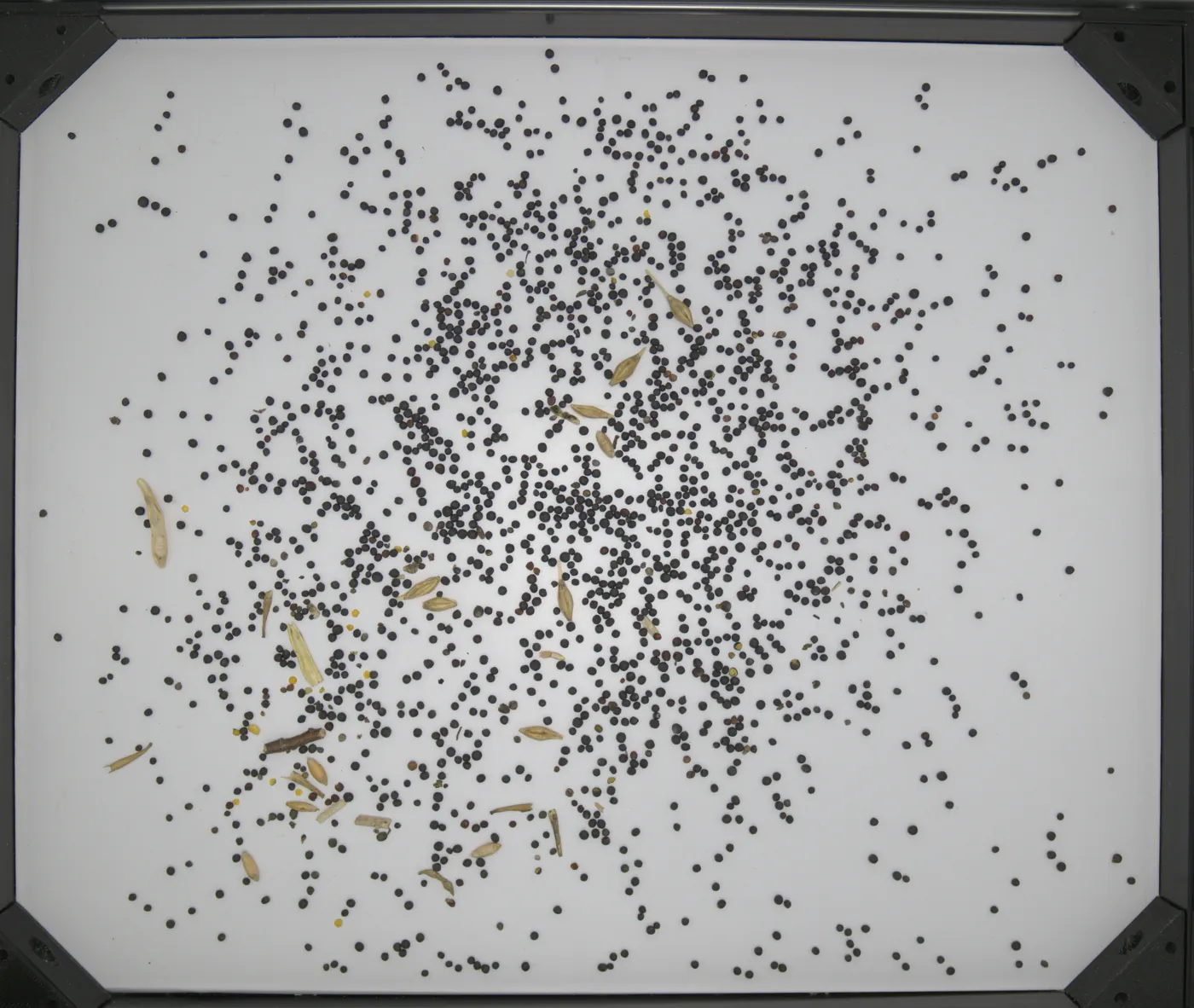
Three problems are specific to rapeseed: look-alike cruciferous weed seeds, green seeds that raise refining costs, and heated or sprouted seeds that hurt oil quality.
Small seeds, a short harvest window and tired eyes at the end of a shift make manual rapeseed inspection hard to keep consistent.
AI image analysis handles the visual side (sound, damaged and foreign seeds, other material). Oil content and moisture are measured by other instruments.
Sekargas Hamilton, an independent GAFTA and FOSFA certified inspection company in Klaipėda, uses GrainODM on both wheat and rapeseed.
Search for an impurity standard for rapeseed and you often land on cereal content. Much of the European guidance on Besatz is built on EN 15587, and EN 15587 is a cereal standard by name and by scope. Our own EN 15587 Besatz guide stops at the same line.
Rapeseed is the EU’s largest oilseed crop. In 2025 the EU harvested about 20.0 million tonnes, and four countries grew nearly three quarters of it: France (4.6 million tonnes), Germany (4.0), Poland (3.5) and Romania (2.5), according to Eurostat crop production data.
That leaves a gap for the people who handle rapeseed every summer: quality managers at oilseed crushers, port inspection labs, terminals and co-ops. This guide is for them. It covers which standard applies, how contracts treat impurities, why rapeseed is hard to inspect consistently by hand, and where AI image analysis fits.
Why EN 15587 does not apply to rapeseed
EN 15587 sets out how to determine Besatz in common wheat, durum wheat, rye, triticale and feed barley. It does not cover oats, maize or malting barley, and rapeseed was never part of it, because rapeseed is not a cereal.
The categories are different too. Cereal Besatz counts broken kernels, shrivelled grains, sprouted grains and grain admixture. In rapeseed, contracts price impurities (called Besatz in German trade, but defined differently from EN 15587), oil content and moisture. A wheat checklist applied to a rapeseed sample answers the wrong questions.
| Wheat (cereals) | Rapeseed (oilseed) | |
|---|---|---|
| Reference method | EN 15587 (Besatz in cereals) | ISO 658 / EN ISO 658 (impurities in oilseeds) |
| Sampling standard | EN ISO 24333 | ISO 542 |
| What is counted | Broken, shrivelled and sprouted grains, other cereals, foreign seeds, extraneous matter | Fine material, non-oil impurities (straw, chaff, stones, non-oil seeds), seeds of other oil plants |
| Sprouted seeds | A Besatz category | Not counted as impurities in German trade; lower oil content is settled through the oil scale |
| Typical contract basis | Set by the contract and national rules | 2% impurities, 9% moisture, 40% oil (Euronext) |
Which standard governs rapeseed impurities
For oilseeds, the reference method is ISO 658:2002, Oilseeds - Determination of content of impurities, adopted in Europe as EN ISO 658. ISO last reviewed and confirmed it in 2024, so it is still the current edition.
ISO 658 does two things:
- It defines the categories that are usually counted as impurities in oilseeds, separating fine material, non-oil impurities and seeds of other oil plants.
- It sets the laboratory method: preparing the test portion, separating the impurities and expressing the result as a share of the sample mass. Sampling itself is covered by a separate standard, ISO 542.
National rules and trade contracts then decide what each category costs. That is where the money is.
How contracts price impurities
The benchmark for European rapeseed is the Euronext rapeseed futures contract. Its standard quality is double-zero rapeseed on a basis of 2% impurities and 9% moisture, with oil content on a 40% basis and a maximum of 3% impurities. Deliveries outside the basis are settled with premiums and discounts.
Physical contracts between growers, collectors and crushers usually follow the same logic. The impurity figure found at intake is not a lab curiosity. It is a number on the invoice, and above the basis every tenth of a percent moves money between buyer and seller. That is why a rapeseed impurity result has to be repeatable and easy to defend, the same way a wheat Besatz result does (see how objective evidence ends intake disputes).
What each percentage point costs: a German example
In Germany, crushers buy rapeseed against so-called Ölmühlenbedingungen. Each crusher sets its own, but according to the German oilseed association UFOP the settlement of the key parameters stays largely uniform across Germany and even Europe. One German crusher’s 2025 purchase conditions show how steep the impurity scale gets:
Two things follow. Below 2%, clean rapeseed earns a bonus, so a result that overstates impurities costs the seller money even on a good lot. And around 4%, a small difference in the result decides whether a lot is settled 1:1 inside the contract or 2:1 outside it.
The same conditions expect disagreement and build a procedure around it. After the first analysis, either party can ask for a control analysis at a recognised lab, and the settlement uses the mean of the two results. If the two differ by more than 1 percentage point, a third analysis is made at an agreed lab, and the mean of the two closest values counts. Each extra round costs time and lab fees, which is why a first result that both sides can check matters.
France and Poland
France works on the same basis. Terres Inovia, the French technical institute for oilseeds, lists the French marketing norms for rapeseed as 2% impurities, 9% moisture and 40% oil. Its 2025 harvest survey of 318 samples found an average of 1.5% impurities. Even so, in a harvest the institute describes as early and taken in good conditions, 18% of samples were above the 2% norm, and individual samples ranged from 0.0% to 11.3%. An average lot sits comfortably inside the basis. The next truck may not.
In Poland, as in every CEN member country, ISO 658 is adopted as a national standard (PN-EN ISO 658), and the state research institute IBPRS uses PN-EN ISO reference methods for moisture and oil in its annual survey of the rapeseed harvest. As elsewhere, the bonus and deduction scale itself is set in the buyer’s purchase terms.
What the analyst actually looks for
At intake, the visual and physical side of a rapeseed sample comes down to four groups:
- Sound seeds: whole, mature, normally coloured rapeseed.
- Damaged seeds: heat-damaged, green (immature) and sprouted seeds, plus broken or split seeds. They affect crush yield and oil quality, not only the look of the sample. Whole damaged seeds are usually not counted as impurities, while seed fragments that pass the sieve are.
- Foreign seeds: weed seeds and seeds of other crops. Some of them are oil plants themselves and are easy to confuse with rapeseed at a glance.
- Other material: straw, chaff, pods, stones, earth and fine dust.
The chemical side (oil content, moisture, glucosinolates, free fatty acids, erucic acid) sits on the same contract but is measured with NIR or NMR analyzers or classical lab methods. It is a different job, done by different instruments.
Three problems that are specific to rapeseed
Look-alike weed seeds. Wild mustard (Sinapis arvensis) and other cruciferous weeds grow in the same fields as rapeseed and produce small, round, dark seeds. Wild mustard seed is somewhat smaller than rapeseed and hard to separate by cleaning. It matters beyond weight: research on Brassicaceae weed seeds in canola shows that such admixture can push erucic acid and glucosinolates, the two parameters that define double-zero rapeseed, above the limits.
Green seeds. Seeds that did not ripen fully, often after frost or uneven maturity, carry chlorophyll into the oil. Chlorophyll has to be removed in refining with bleaching earth, which adds cost and loses oil. An Australian Oilseeds Federation study found that several pale green seeds can add as much chlorophyll as two distinctly green ones, so a count of obviously green seeds alone can understate the problem. Visual inspection flags green seeds; the chlorophyll level itself is a job for NIR or the lab.
Heated and sprouted seeds. Heat-damaged seeds raise free fatty acids in the oil, and German purchase conditions define sound rapeseed as free of unripe, burnt or otherwise damaged seed, with free fatty acids no higher than 2.0% in the oil. Sprouted seeds have a lower oil content, which is settled through the oil scale, while sprouts that have broken off count as impurities (UFOP).
None of this is exotic. It is what a rapeseed analyst looks for after a wet or uneven season, on seeds about two millimetres across.
Why rapeseed is hard to inspect consistently by hand
Rapeseed inspection has the same weak points as wheat inspection, only sharper.
The seeds are small. A rapeseed seed is about two millimetres across. Picking out broken seeds, green seeds and look-alike weed seeds with tweezers is slow, close-up work.
The harvest window is short. Rapeseed comes in early and fast. Labs at ports and collection points get a wave of trucks in a few weeks, often overlapping with the start of the wheat harvest.
Eyes get tired. The last sample of a long shift does not get the same attention as the first one. Two experienced analysts can look at the same tray and land on different numbers, and both can defend their call.
The result has to hold up later. When a seller disputes a deduction, a number written on a sheet is hard to reopen. Nobody can look at that tray again.
None of this is a criticism of lab analysts. It is what happens when a demanding visual task meets peak-season volume.
Where AI image analysis fits
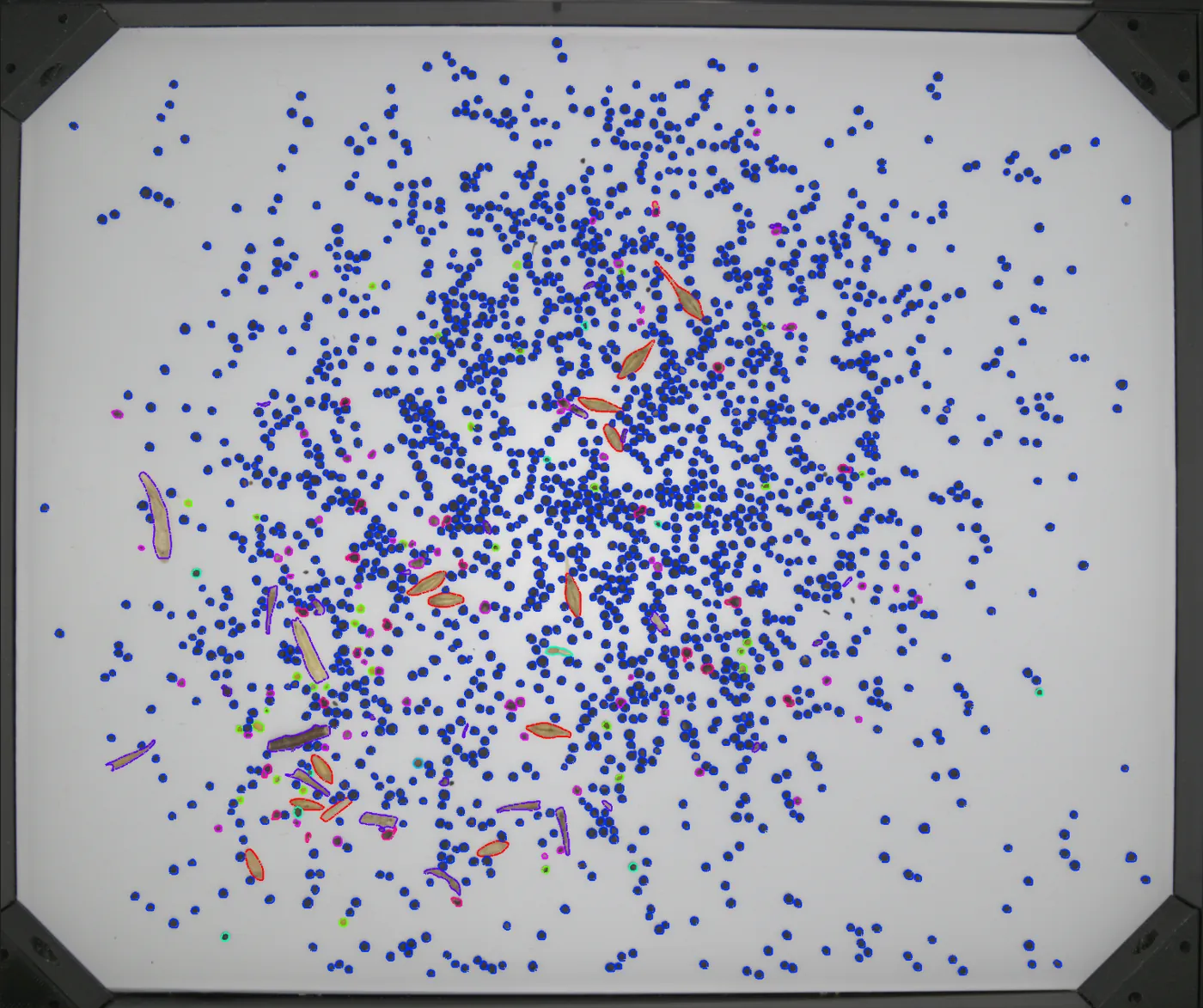
GrainODM takes a photograph of the spread sample, and an AI model trained on rapeseed analyses every seed in it. It separates sound seeds from damaged seeds, foreign seeds and other material, and returns a result for the sample in under a minute.
What that changes at intake:
- The same rules for every sample. The model looks at the first truck and the last truck of the shift in the same way.
- A record you can reopen. Every result comes with the image and the per-seed marking behind it. When a control analysis is requested, both sides can see exactly which seeds were counted and why, even weeks later.
- Analysts focus where it matters. Instead of counting every seed by hand, the analyst reviews the result and steps in on borderline or unusual samples.
- Peak season without extra specialists. Seasonal staff can run the scan, so the rapeseed wave does not have to wait for a specialist.
- One device for several crops. The same unit runs wheat, barley, oats, rapeseed and hemp models, so a mixed-crop lab does not need a separate system for the rapeseed season.
What it does not do: measure oil content, moisture or any chemical parameter.
Sekargas Hamilton, an independent GAFTA and FOSFA certified inspection company in the port of Klaipėda and part of the J.S. Hamilton Group, uses GrainODM on both wheat and rapeseed.
For an inspection company, the point is not only speed. As Nikolaj Stankevič, Head of Inspections at Sekargas Hamilton, put it:
We work every day in an environment where data accuracy, traceability and trust are essential.
That is the standard an impurity result has to meet, whether the crop is wheat or rapeseed.
Questions to ask before you automate rapeseed intake
If you are weighing an automated approach for the next rapeseed harvest, these are the questions worth settling first:
- Which categories does your contract actually price? Start from the contract and your internal rules, not from a generic list.
- Who checks borderline samples? Some labs keep a manual review step for results near a contract limit, at least in the first season.
- How will results reach your systems? A result that has to be typed in by hand loses part of its value.
- Can the model be trained on your samples? Rapeseed from different regions and seasons looks different. A model tuned on your own material will fit your intake better than a generic one.
See it on a real sample
Rapeseed has had its own standard for a long time. It has rarely had its own guide. If you handle rapeseed and want to see how image-based impurity analysis works on a real sample, try the interactive demo. We’d be glad to walk you through it.
Frequently Asked Questions
No. EN 15587 is a cereal standard. It covers common wheat, durum wheat, rye, triticale and feed barley. Rapeseed is an oilseed, so its impurity content is determined under ISO 658 (EN ISO 658) and the terms of the trade contract.
ISO 658:2002, Oilseeds - Determination of content of impurities. It is adopted in Europe as EN ISO 658 and was last confirmed by ISO in 2024. It sets the method and defines the categories that are usually counted as impurities in oilseeds.
Typically fine material (dust, earth, seed fragments that pass the sieve), non-oil impurities such as straw, chaff, stones and seeds of non-oil plants, and seeds of other oil plants. Whole damaged seeds (heated, green or sprouted) are usually not counted as impurities. Depending on the contract they are recorded as a separate damage factor or show up in chemical parameters such as free fatty acids. The exact definitions and penalties come from the contract.
No. GrainODM analyses what can be seen: sound seeds, damaged seeds, foreign seeds and other material. Oil content, moisture, glucosinolates and free fatty acids are chemical parameters measured by NIR or NMR analyzers or laboratory methods. The two sit side by side in the same intake lab.
German crushers settle against their own Ölmühlenbedingungen, which stay largely uniform across the market. In one crusher’s 2025 conditions, impurities up to 2% earn a 0.5:1 bonus, 2% to 4% is deducted 1:1 from the contract price, and above 4% the lot is outside the contract and deducted on a steeper scale (2:1 up to 6:1). Sprouted seeds are not counted as impurities.
No. Small seed size is exactly what makes manual counting slow and tiring. A camera and model look at every seed in the sample in the same way, whether it is the first sample of the shift or the last. GrainODM runs a dedicated rapeseed model.
 Live demo
See the AI in action
Run a real sample, no signup.
Try the live demoFollow GrainODM
Grain-tech insights, case studies and product updates.
Follow on LinkedInContinue reading
GrainODM at the Grain Processing and Baking Conference 2026 in Sopot
GuidesGrain Quality Disputes at Intake: How Objective Visual Evidence Ends the Argument
CompanyGrainODM at Linas Agro Open Doors 2026: AI Grain Analysis, Live in the Lab
Case StudiesFrom Tweezers to Imaging: Grain Impurity Analysis at a GAFTA-Approved Port Laboratory
See the AI analyze a real grain sample
Run a sample in your browser and watch it flag every impurity. No signup, no sales call.