


Key Takeaways
Composition tests such as protein and moisture are instrument-driven. Impurity determination is different: fractions are separated physically, grouped and weighed, and in most laboratories that is still hand work.
Sekargas Hamilton is an independent inspection and quality control company at the port of Klaipėda, part of the J.S. Hamilton group, holding GAFTA Analyst, GAFTA Superintendent, GAFTA Fumigation and FOSFA certifications.
Their Laboratory Manager describes impurity determination as the most time-consuming and attention-demanding work in the laboratory, on samples whose condition is unknown until they arrive.
The laboratory already runs a second-check layer on borderline parameters that affect grade and price deductions.
Sekargas Hamilton evaluated GrainODM on this specific determination in their own laboratory, on samples from their normal working flow, with their own specialists analysing the same samples manually alongside it.
The laboratory's position is that verification stays with people. What changes is what verification costs: an automated analysis leaves an image that can be reopened, rather than a sample that has to be worked again.
Almost every measurement in a modern grain laboratory has been handed to an instrument. Protein, moisture, test weight: a sample goes in, a number comes out, and the specialist moves on. Grain analyzers have absorbed that entire category of work.
One determination has been slower to follow.
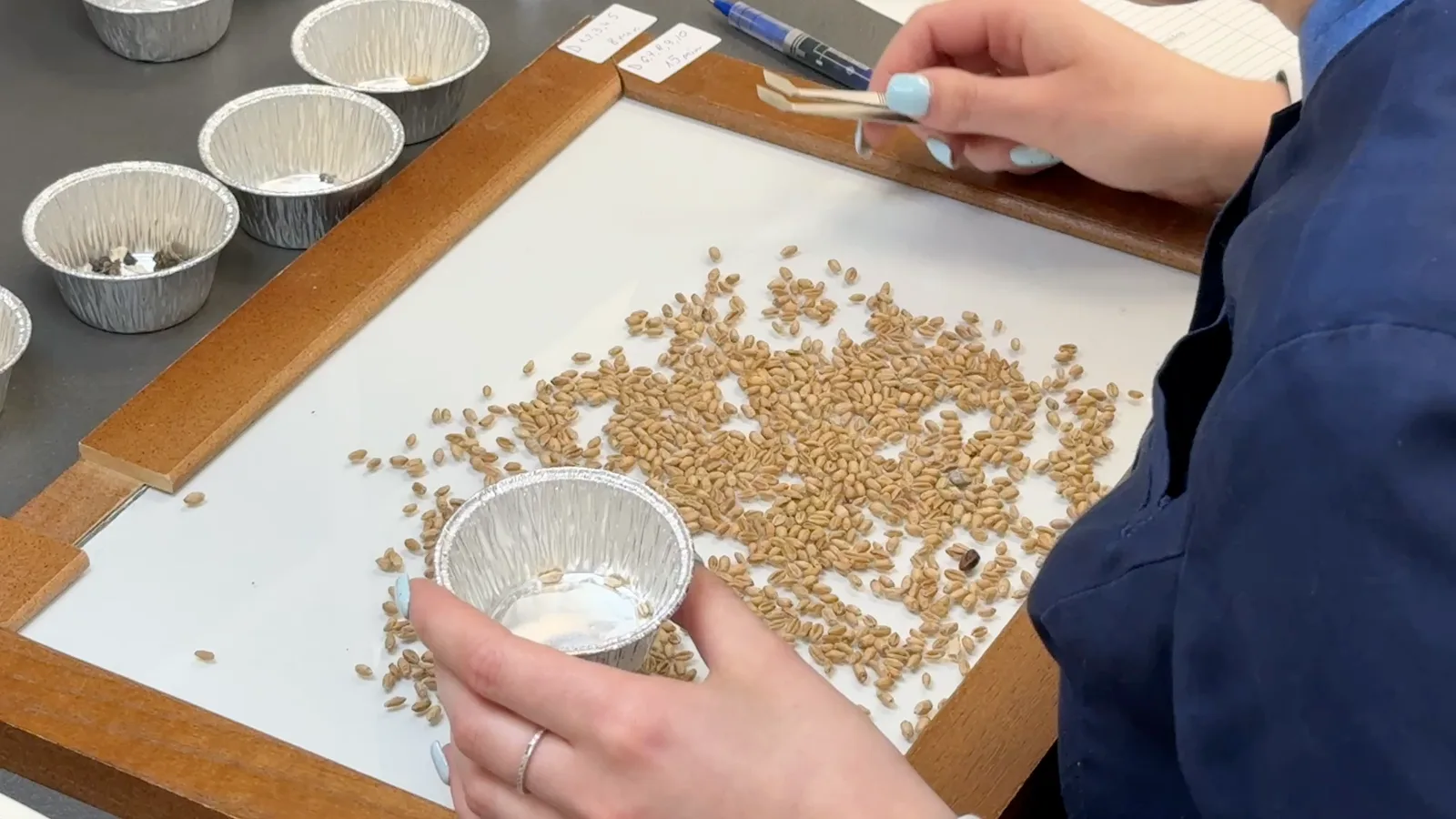
Impurity analysis, known across European trade as besatz, is still done in most laboratories the way it was decades ago: a sample spread across a tray, and a person separating it, fraction by fraction, with a pair of tweezers. It is also the determination that decides grade and price deductions on a cargo.
At the port of Klaipėda, Sekargas Hamilton runs that test every working day. The company is an independent inspection and quality control business serving exporters, importers, traders, processors and logistics companies across the Baltic region. It is part of the international J.S. Hamilton group and is certified to GAFTA Analyst, GAFTA Superintendent, GAFTA Fumigation, FOSFA International and ISO 9001. In 2025 it began working with GrainODM on automating this one determination.
What the test actually asks a person to do
Ask someone who does this work daily what impurity determination involves, and you do not get a procedure. You get a list of judgements.
When picking grain impurities, the most important thing is to separate all the various kinds of damage, impurities, harmful seeds. Right now, for example, quite a lot of cleavers are found. That is a harmful seed and it cannot be in the sample. It can be, up to a certain amount, but not exceeding the norms.
— Karolina Miliauskaitė, Laboratory Manager, Sekargas Hamilton
Cleavers are one entry on a long list. Some weed seeds are classified as harmful and are capped by tight limits. Others are not. The two groups sit side by side in the same tray, and telling them apart is the job.
Some seeds are harmful, others are not, so we have to separate them. The same with broken, small and trash impurities. Those have to be picked out by hand.
— Karolina Miliauskaitė, Laboratory Manager, Sekargas Hamilton
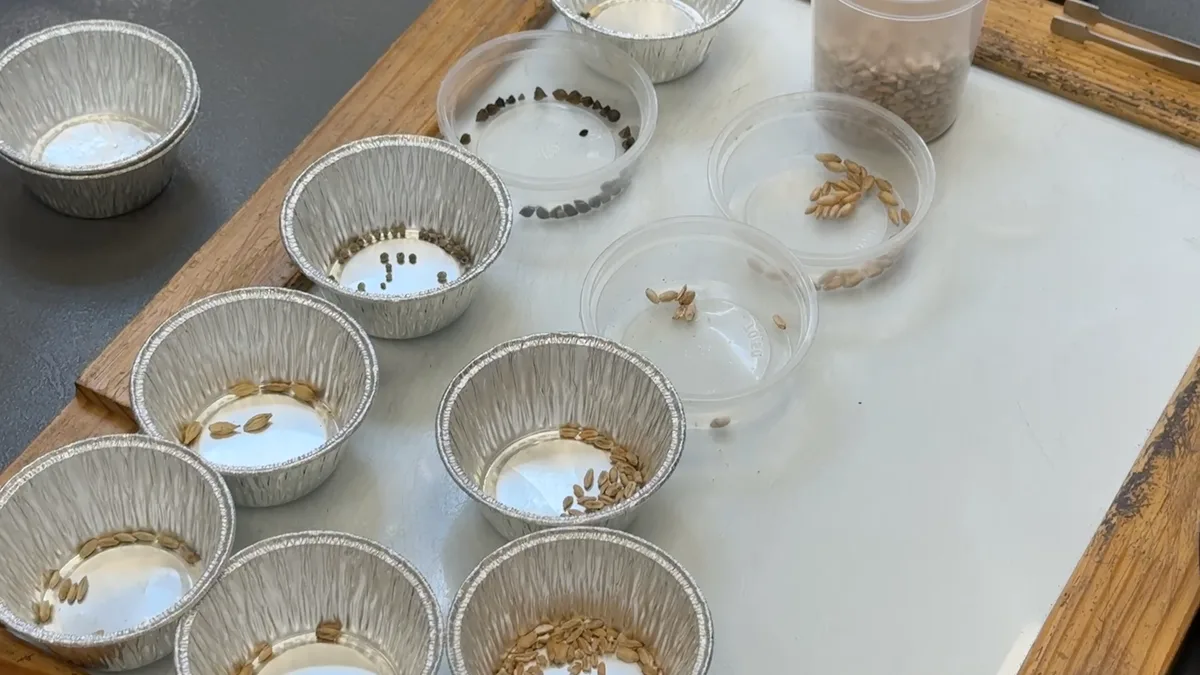
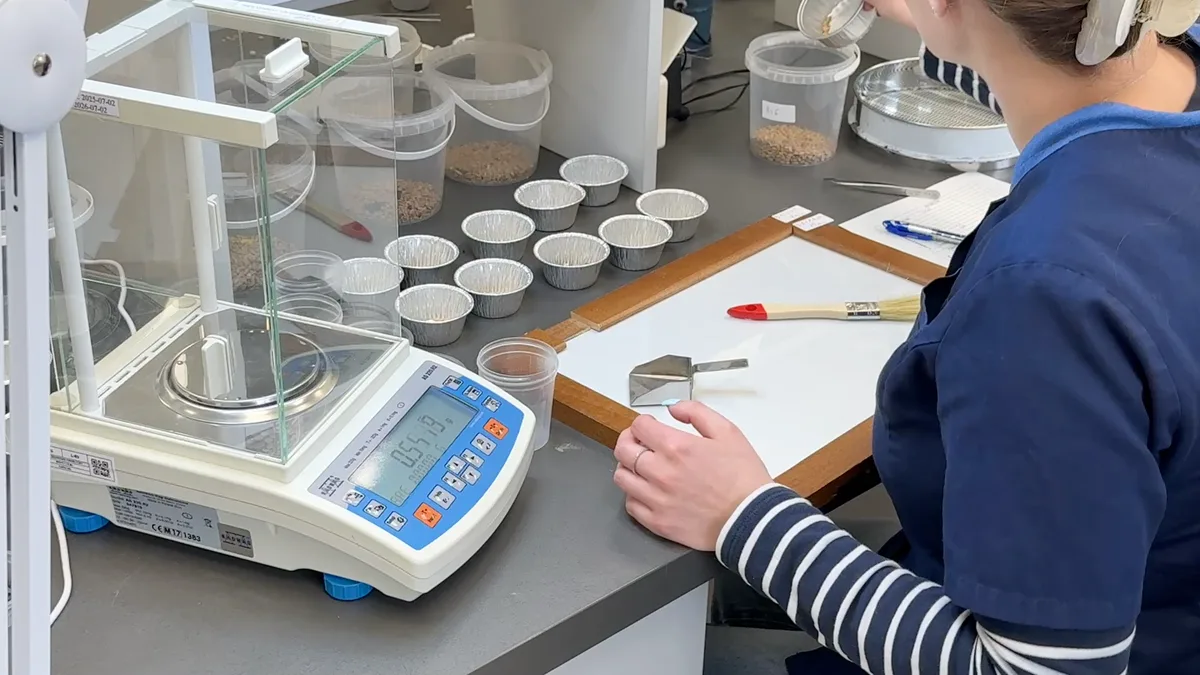
The separation itself is physical. Composition analysis reads how a sample absorbs and transmits light; impurity determination requires the sample to be taken apart, grouped into fractions and weighed. Automated imaging systems for this determination do exist, and the enterprise segment has had them for years, but adoption across inspection laboratories remains uneven. The EN 15587 framework defines which fractions exist and how they are handled; it does not make the separation any less physical. You can see a live grain impurity analysis and the interactive per-kernel report it produces.
The most demanding hour in the laboratory
Every laboratory has a test that sets the pace of the day. In a grain inspection lab, this is it.
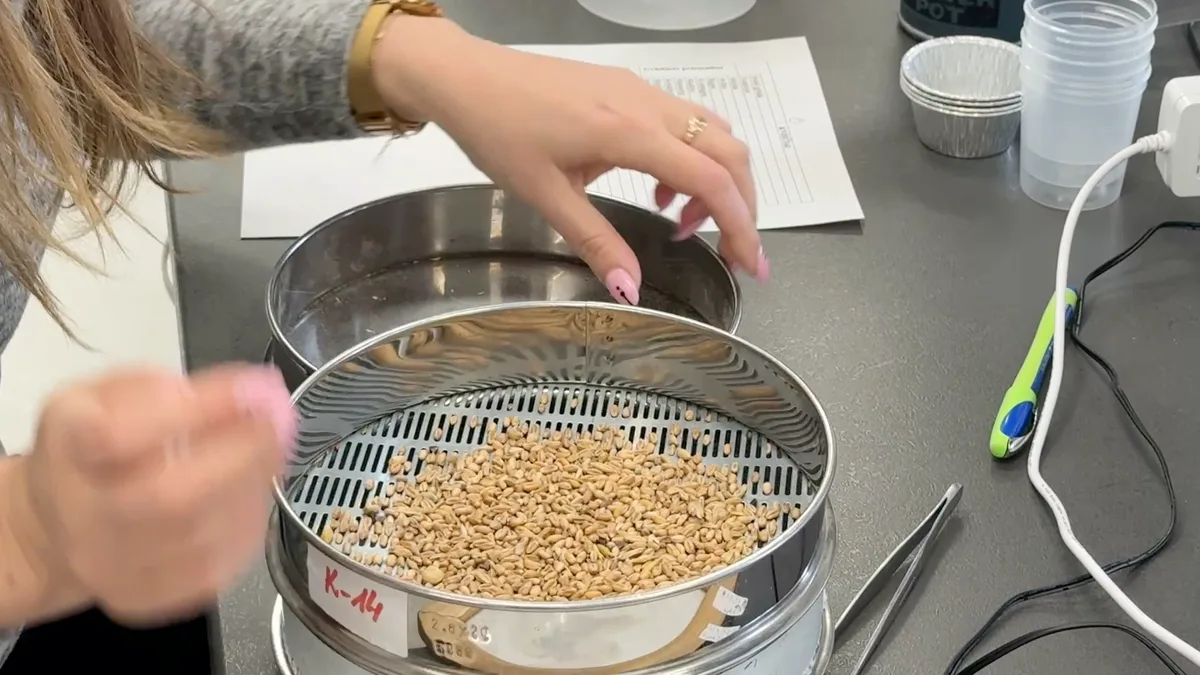
Determining impurities is the most time-consuming, resource-intensive and energy-draining work. And it really requires attention.
— Karolina Miliauskaitė, Laboratory Manager, Sekargas Hamilton
The word that matters there is attention. The constraint is not the sieving or the weighing. It is sustained visual concentration across a tray of several thousand kernels, repeated sample after sample, where a missed classification does not announce itself.
The workload is also unpredictable in a way that laboratory planning cannot smooth out.
We really don’t know in advance what samples will arrive. They can be heavily contaminated, with a lot of impurities, or they can be clean.
— Karolina Miliauskaitė, Laboratory Manager, Sekargas Hamilton
A cargo does not book a slot. A clean sample and a heavily contaminated one arrive through the same door, and the second one takes considerably longer to resolve than the first. Seasonal peaks compress that further. Preparation for the season begins a month in advance, and the laboratory trains additional staff for it.
Why the company went looking
From the inspections office, the same test looks like a business exposure rather than a workload.
Cargo and quality control processes are becoming increasingly complex, and clients expect faster information and greater data transparency. A large part of these processes has historically relied on manual data collection and administration, so we saw an opportunity to increase efficiency, reduce the risk of errors and ensure even better data traceability throughout the inspection process.
— Nikolaj Stankevič, Head of Inspections, Sekargas Hamilton
Impurity determination is where that shows most clearly. It is manual from beginning to end: the separation, the weighing, and then the result written onto a form by hand. The result is reliable because trained specialists and a second-check routine stand behind it. What it does not carry with it is a record of how it was reached.
That framing also shaped how the company chose who to work with.
We were looking for a partner who understands not only technology, but the specifics of grain trading and quality control. It was important to us that the solution matched real inspection processes, ensured data integrity and traceability, and could be developed alongside business needs. We also valued flexibility, responsiveness, and a willingness to listen to user feedback.
— Nikolaj Stankevič, Head of Inspections, Sekargas Hamilton
Putting imaging next to the tray
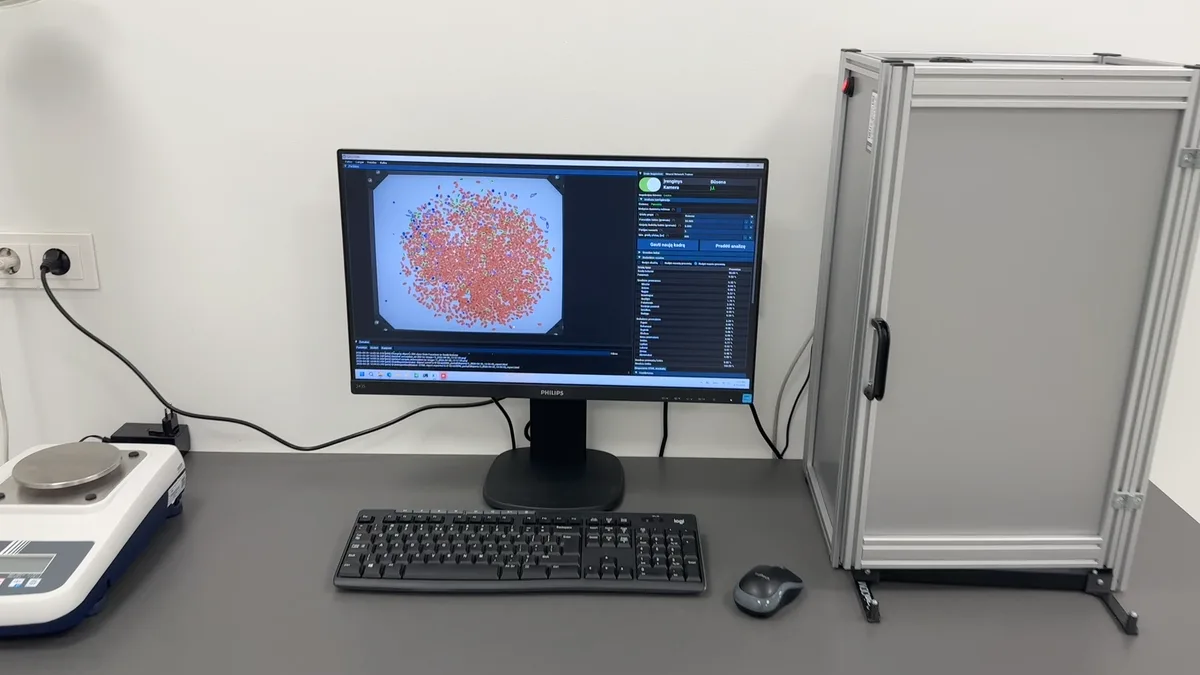
The pilot deliberately covered this determination and nothing else: the same sample, the same EN 15587 fractions, imaged and classified automatically. Throughout, it ran in Sekargas Hamilton’s own laboratory, on samples arriving through their normal flow, and the same samples were worked manually alongside it by the laboratory’s own specialists.
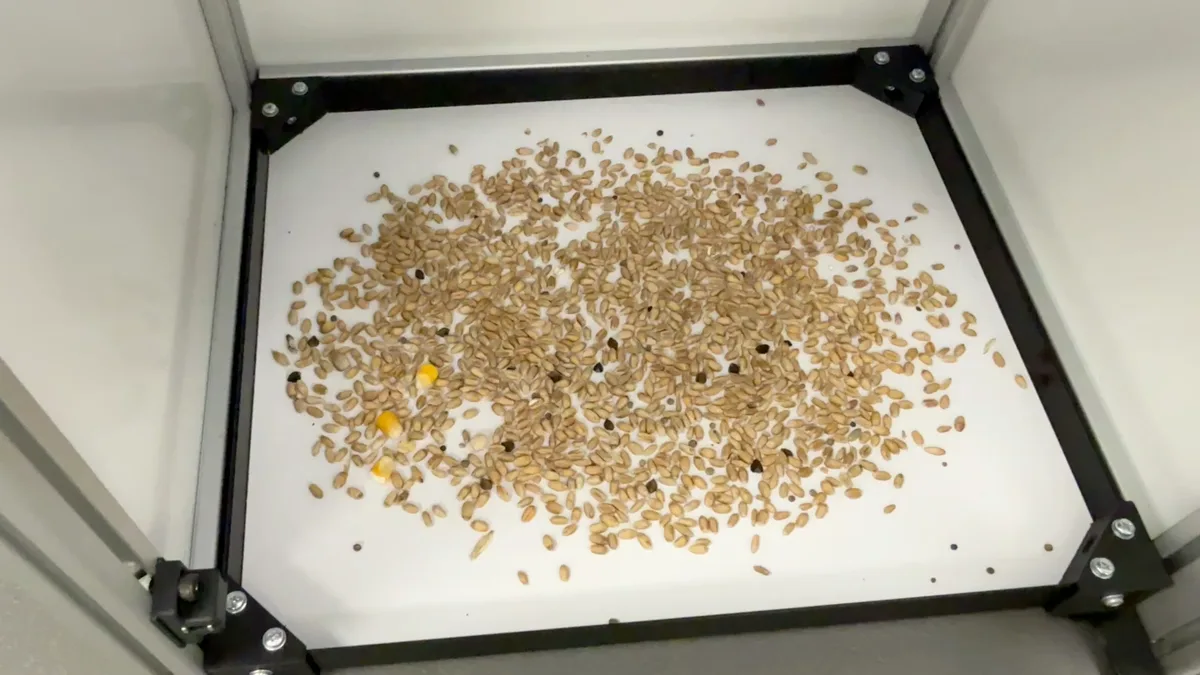
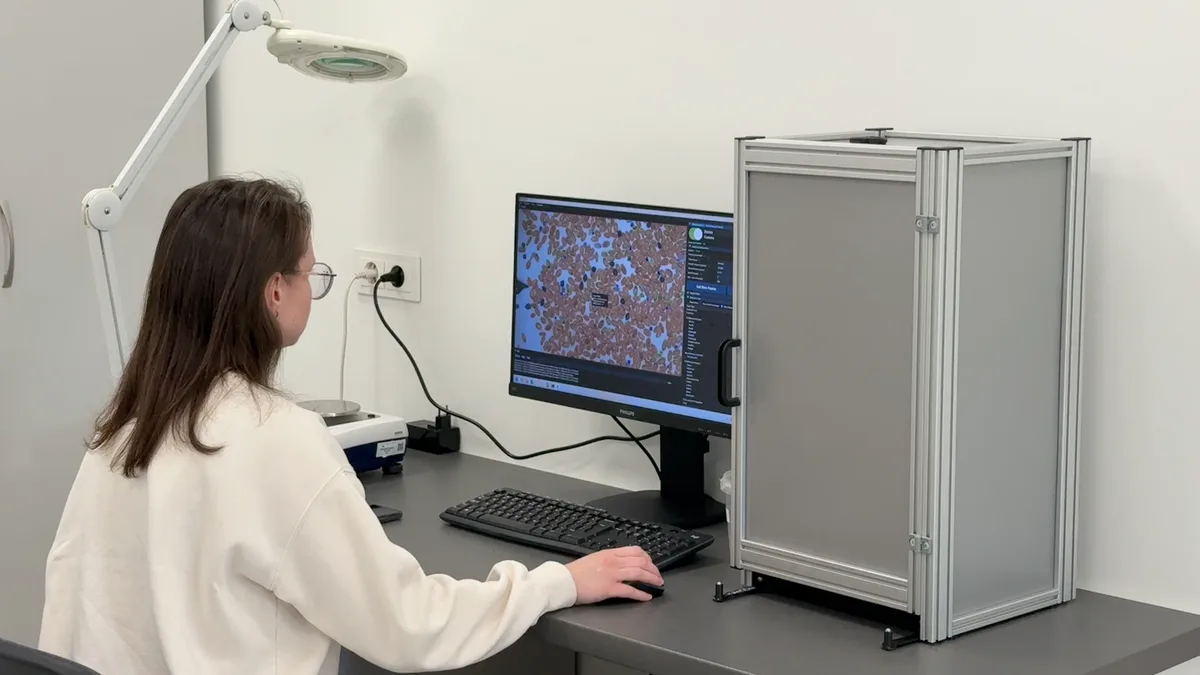
What gets noticed first is not the classification. It is the pace, and the fact that the result is visible rather than numerical.
The first impression was that it does it very quickly. And that it marks everything immediately, so you can look and see what impurities are there.
— Karolina Miliauskaitė, Laboratory Manager, Sekargas Hamilton
The second observation concerns the interface, which in a laboratory is not a minor point. Software that demands attention is competing with the sample for exactly the resource the work is short of.
Using it is really very simple, easy. There is not much to memorise. Everything is clearly written: what you need to submit, you press the button, and it analyses.
— Karolina Miliauskaitė, Laboratory Manager, Sekargas Hamilton
Where a specialist disagrees with a classification, the correction is made on the spot, against the sample still in hand.
You don’t need to write the information down somewhere separately, photograph it, insert it. It’s very convenient, because you check immediately, with the sample in your hand, whether it really looks like that, and you change it right away.
— Karolina Miliauskaitė, Laboratory Manager, Sekargas Hamilton
What the laboratory keeps
The most useful thing said during these conversations was an answer to a question about trust. Asked whether an automated result should be checked, or whether checking could be reserved for borderline cases, the answer was immediate and unsentimental.
In my opinion, you always need to check. Even the best sometimes makes mistakes, and because of the pace, a second pair of eyes is always good.
— Karolina Miliauskaitė, Laboratory Manager, Sekargas Hamilton
The laboratory already works this way. Second checks are concentrated on borderline parameters, the ones that determine grade and price deductions, and on periods when seasonal staff are working alongside permanent specialists.
So verification is not the question. The question is what verification costs. And here the Laboratory Manager drew a distinction worth sitting with:
A person is harder to re-check. The program took a photo, showed it, and you can already see it, and it’s clear.
— Karolina Miliauskaitė, Laboratory Manager, Sekargas Hamilton
Re-checking a manual analysis means confronting the fact that the analysis consumed its own working state. The fractions have been separated, weighed, recorded and returned. A retained sealed sample still exists for arbitration, but it answers a different question: it allows a fresh analysis, not a review of the original one. To verify a classification, a second specialist has to work the sample again, and what they produce is a second analysis rather than an examination of the first.
An imaged analysis behaves differently. The record persists in the state it was made. Reviewing it is looking, not repeating.
How the pilot ran
The laboratory was explicit throughout that it was evaluating rather than accepting.
The pilot stage was constructive and result-oriented. The GrainODM team actively collaborated with our specialists, responded quickly to observations, and sought to understand real working processes. We appreciate that communication throughout the project was open and effective.
— Nikolaj Stankevič, Head of Inspections, Sekargas Hamilton
That is the part of this story we would highlight to anyone considering the same step. Sekargas Hamilton did not take a supplier’s description of a system at face value. They put it into their own laboratory, in front of their own specialists, on their own samples, and formed a view from there.
For a company whose product is independent verification, that sequence is the whole point.
What Sekargas Hamilton would say to a peer
Asked what he would tell a colleague in the industry who is weighing up automation, the Head of Inspections was direct about sequencing.
Process automation today is becoming not a competitive advantage, but a natural direction of business evolution. The most important thing is to start from clearly identified processes and to choose a partner who understands the specifics of your operations.
— Nikolaj Stankevič, Head of Inspections, Sekargas Hamilton
In a grain inspection laboratory, few processes are as clearly identified as this one: it takes the most time, demands the most attention, and still ends with a number written by hand onto a form. What imaging changes is not who makes that call. It is what is left afterward to check it against — a photograph, rather than a sample that has already been returned to the mix.
Frequently Asked Questions
It is the determination of everything in a grain sample that is not sound grain of the contracted type: harmful and non-harmful weed seeds, broken kernels, shrunken kernels, foreign matter, and damaged grain. Under EN 15587 these fractions are separated, grouped and weighed, and the result feeds directly into grade and price deductions.
Because it is a physical separation task rather than a spectral measurement. NIR instruments measure composition, such as protein and moisture, from how a sample absorbs light; they do not sort a sample into fractions. Automated imaging systems for impurity determination do exist, but adoption is uneven, so in most inspection laboratories the separation and weighing remain manual work with sieves, tweezers and a balance.
Not as an autonomous decision-maker. In the approach used at Sekargas Hamilton, automated imaging acts as a fast first pass and a visual record, while the laboratory keeps verification and the final call with its specialists, particularly on borderline parameters that affect grade.
An image of the analysed sample with detected objects marked by category, alongside the numerical result. Because the image is retained, a result can be reopened and reviewed later without repeating the physical analysis.
No. EN 15587 defines what is measured and how fractions are classified. Automation is a method of arriving at those same fractions faster, within the framework the standard sets.
An independent inspection and quality control company operating at the port of Klaipėda, Lithuania, and part of the international J.S. Hamilton group. It provides sampling, cargo inspection, laboratory testing and certification for agricultural and other commodity sectors, and is certified to GAFTA Analyst, GAFTA Superintendent, GAFTA Fumigation, FOSFA International and ISO 9001.
 Live demo
See the AI in action
Run a real sample, no signup.
Try the live demoFollow GrainODM
Grain-tech insights, case studies and product updates.
Follow on LinkedInContinue reading
A GAFTA-Accredited Lab Tested Our AI Against Its Own Technicians. Here's the Review.
Case StudiesHow AI Cut Allive's Hemp Seed Inspection From 30 Minutes to Seconds
Case StudiesAI vs. 5 Lab Technicians: What We Found After 4 Months and 600+ Wheat Tests
Case StudiesManual Wheat Sprout Detection Fails: AI vs. Human Eye
See the AI grade a real grain sample
Run a sample in your browser and watch it flag every impurity. No signup, no sales call.