


Key Takeaways
Allive replaced 10 to 30-minute manual hemp seed analysis with AI-powered inspection that returns results in seconds.
Green hull sorting, which previously took up to 2 hours per sample, now completes in seconds. This is an order-of-magnitude change in what the lab can deliver in a day.
A 6-month pilot produced a hemp-specific AI model with 30+ impurity classes (including Ergot, Sclerotium, Ragweed, and Common wild oat), validated on Allive's full production sample set.
On export-critical impurity types such as oxidized hemp seeds, results consistently match Allive's lab.
Allive's Product Compliance Manager describes the shift as moving from 'looking' to 'measuring' - quality as fact, not opinion.
Each inspection produces a reopenable digital record with every object segmented and classified. A live example from Allive's production line (6,251 grains detected) is linked inside the post.
JSC Allive is one of the largest vertically integrated organic industrial hemp producers in Europe, supplying food and wellness markets in the EU, US, Canada, and Japan. Those are markets that do not tolerate compromise, and Allive’s Product Compliance Manager, Tadas Brazdauskas, frames it plainly:
We’re not just another hemp company. We’re the kind where quality isn’t marketing. It’s a daily decision. We work with markets where there are no compromises, so we don’t make any either.
- Tadas Brazdauskas, Product Compliance Manager
In late 2025, Allive and GrainODM started a structured six-month pilot to replace manual hemp seed grading with AI-powered inspection. Six months of weekly review cycles later, the process they describe is no longer visual estimation. It is digital measurement. Or, as Tadas puts it later in this story: quality has become a fact, not an opinion.
This is the story of that shift, told in the words of the people who ran it: Tadas and Emilija Nugarienė, Junior Laboratory Manager at Allive.
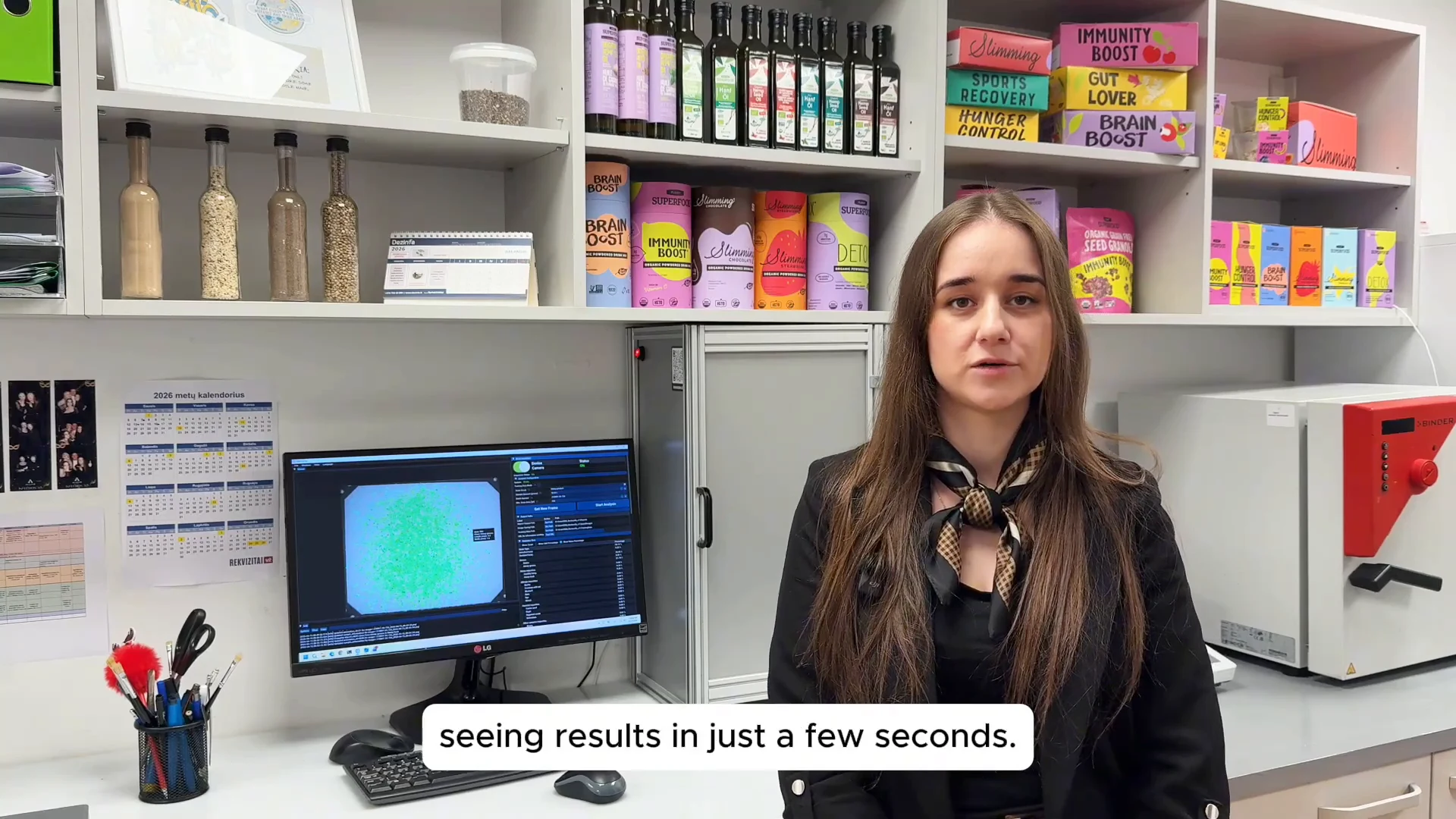
Watch Tadas and Emilija describe the pilot in their own words (2:33, English subtitles).
The moment the manual process stopped scaling
Either we change the process, or the process will hold back our growth.
- Tadas Brazdauskas, Product Compliance Manager
Hemp inspection at Allive used to be entirely manual. Each impurity was counted and weighed individually, then recorded in journals and copied into Excel, with the constant risk of transcription errors along the way.
“A standard sample took about 10 minutes,” Emilija recalls. “But some processes, like sorting and counting green hulls, could take up to two hours. A typical day ran 20 to 30 analyses, depending on production.”
The real pressure came from edge cases. Sorting and counting green hulls on a single sample could take up to two hours. With AI inspection, that same check now returns in seconds. It is the kind of order-of-magnitude shift that changes what a lab can physically do in a day, not just how long individual tasks take.
At Allive’s production rate of roughly 500 kg of cleaned hemp raw material per hour, a slow lab means a slow line. Every additional kilogram of uncertain quality is a risk to premium export commitments.
The bottleneck was not about one slow sample. It was about whether quality control could keep up with the company’s growth.
What would this time shift be worth at your throughput?
Allive averaged 20 to 30 samples per day at 10 to 30 minutes each. Estimate what replacing manual grading could recover in lab hours and throughput at your own operation.
Try the ROI calculator →Why Allive refused a plug-and-play AI tool
Hemp seeds are not wheat. The impurities Allive has to catch (foreign seeds, oxidized kernels, unripe seeds, hulls and shell fragments, debris) overlap with clean seeds in color, shape, and size. Off-the-shelf computer vision models, trained on standard grains, struggle with that overlap.
We weren’t looking for technology so much as the brains behind it.
- Tadas Brazdauskas, Product Compliance Manager
“If a partner doesn’t understand your product, AI won’t help,” Tadas says. “Hemp seeds aren’t simple wheat. The impurities can be very similar in color, form, and size. It was critical for us that the model would be trained on the impurities we’ve collected over a long period, with our experience behind it.”
That framing set the scope. This would not be a software install. It would be a joint development project.
Inside the six-month pilot
The pilot structure was deliberately hands-on. Allive’s lab supplied samples and flagged edge cases. GrainODM retrained the model each week and shipped updates. The cadence ran from October 2025 through March 2026, with formal weekly reviews captured in a 96-page joint review log that tracks every observation, model change, and resolved edge case.
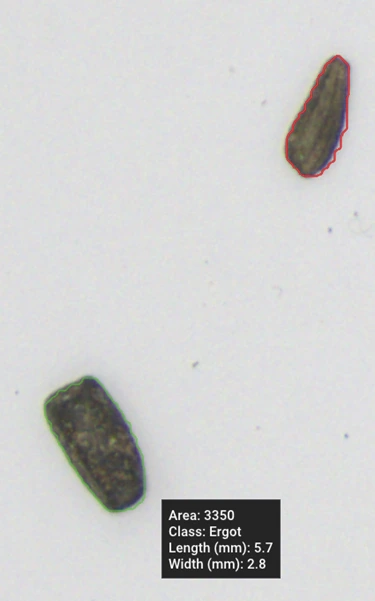
The trajectory of the model is easiest to see through its classification depth. In the early weeks, impurities that did not cleanly match any trained class got dumped into a catch-all “other seeds” bucket. By the end of the pilot, that bucket had been replaced by more than thirty specific impurity classes - including export-critical ones such as Ergot, Sclerotium, Ragweed, and Common wild oat - grouped under the three categories Allive’s QC framework uses: allergenic, hazardous, and harmful impurities.
By February 2026, the model was hitting production-grade accuracy on Allive’s full production sample set across more than thirty impurity classes. On export-critical impurity types where Allive monitors strict thresholds - oxidized hemp seeds among them - results consistently matched the lab.
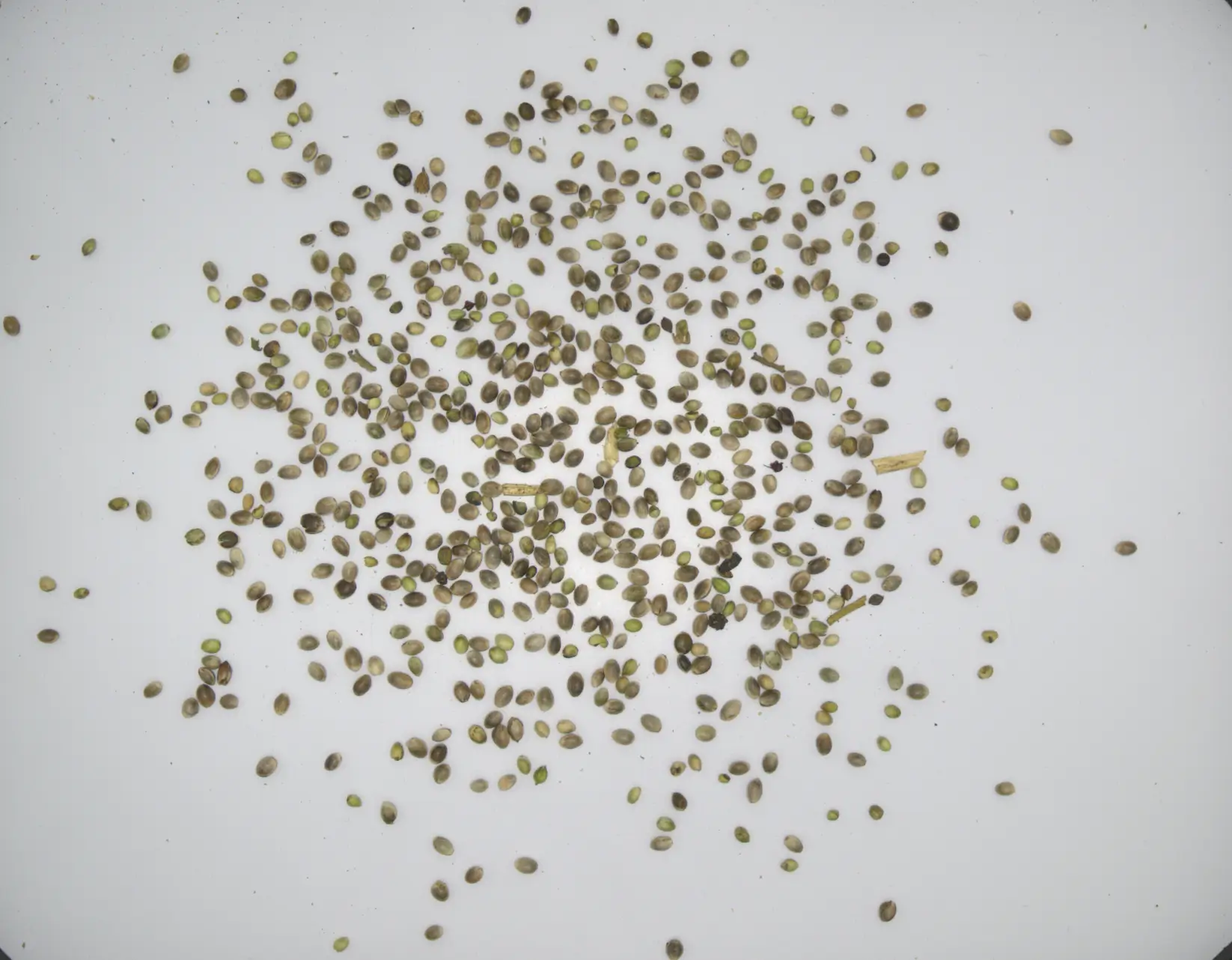
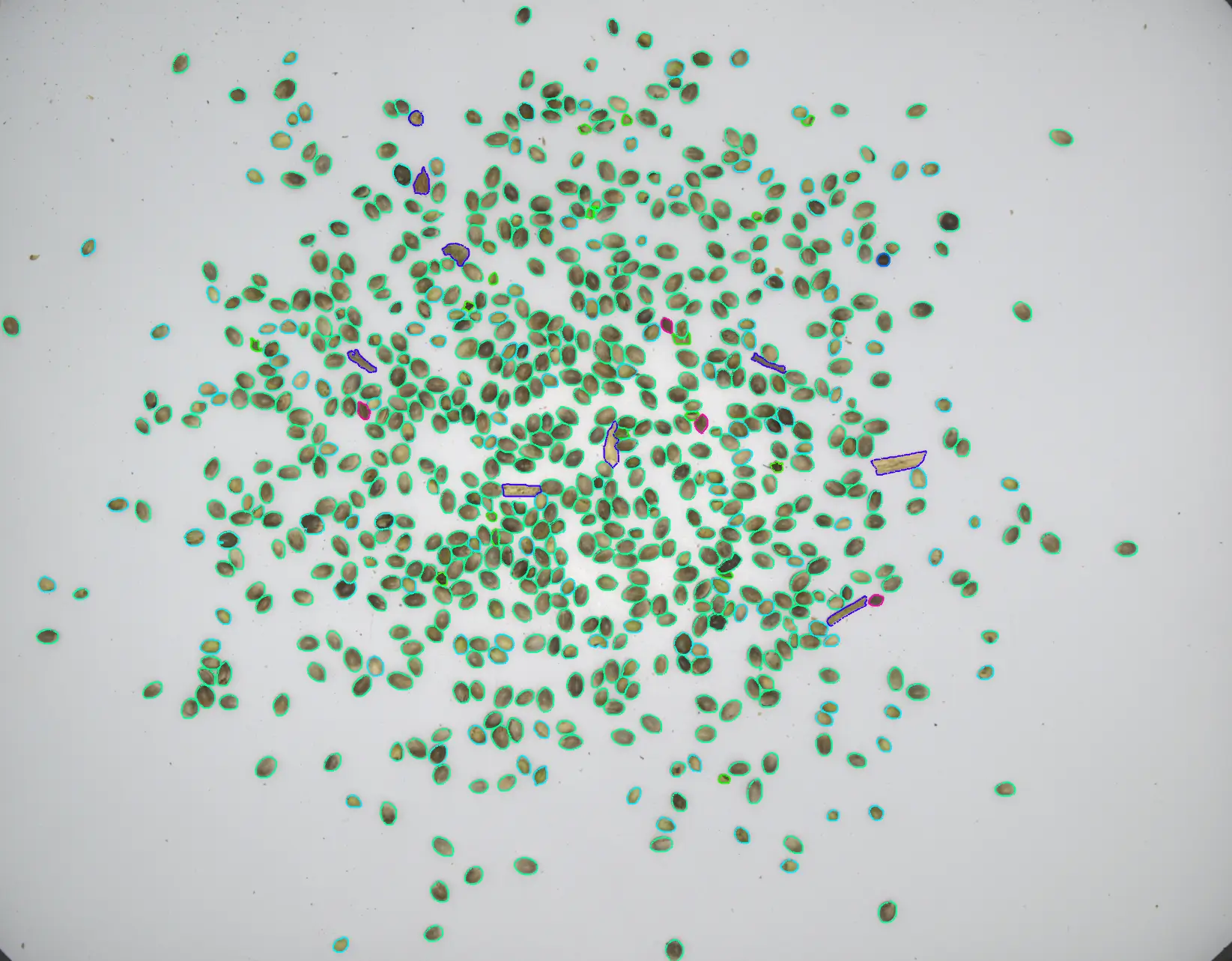
The same hemp seed sample at Allive, before and after GrainODM AI inspection: raw plate versus segmented and classified detections.
Emilija watched the progression from the lab side. “Over the pilot, the system kept improving. With each update it recognized our seed types and impurities more accurately. It was obvious that the team was actively working with our data, and that the model’s accuracy was steadily getting better.”
“We were demanding. And it’s good that they held up,” Tadas says. “The model was trained on our data, and we were elbow-deep in the process. Some things took longer than we expected, but our own expectations kept growing along the way. This wasn’t ‘buy it and use it’. It was ‘build it together’.”
Since March 2026, GrainODM has been running as part of Allive’s standard quality control workflow - every batch passes through the AI model, and new impurity classes continue to be added as production mixes evolve.
From the lab floor: speed and evidence
Emilija works hemp samples every day. Her routine mixes impurity counting, sorting unripe and dehulled seeds, documentation, and auditing the production line. She has the clearest view of what the work looked like before and after AI landed in the lab.
For her, the first change was physical. “What surprised me most was the speed. Results in a few seconds. It was an obvious change compared to the manual work we had done until then.”
Beyond the clock, two things turned out to matter more day-to-day than either side predicted at the start.
Structured categories in the report. “It’s very convenient that the results come in a structured table,” Emilija says, “where the categories - allergenic, hazardous, harmful impurities - and their totals are clearly visible.” No interpretation step stands between the analysis and an auditor’s question.
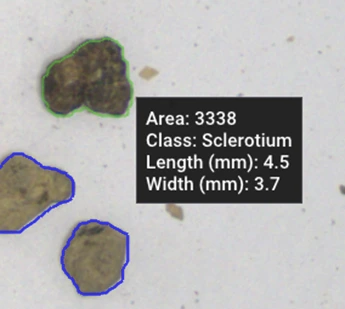
A record you can send. Every analyzed sample keeps its full interactive report. When a buyer or auditor disputes a batch, Allive sends them the file. They open it, zoom in, and see exactly what the lab saw. There is nothing left to argue about.
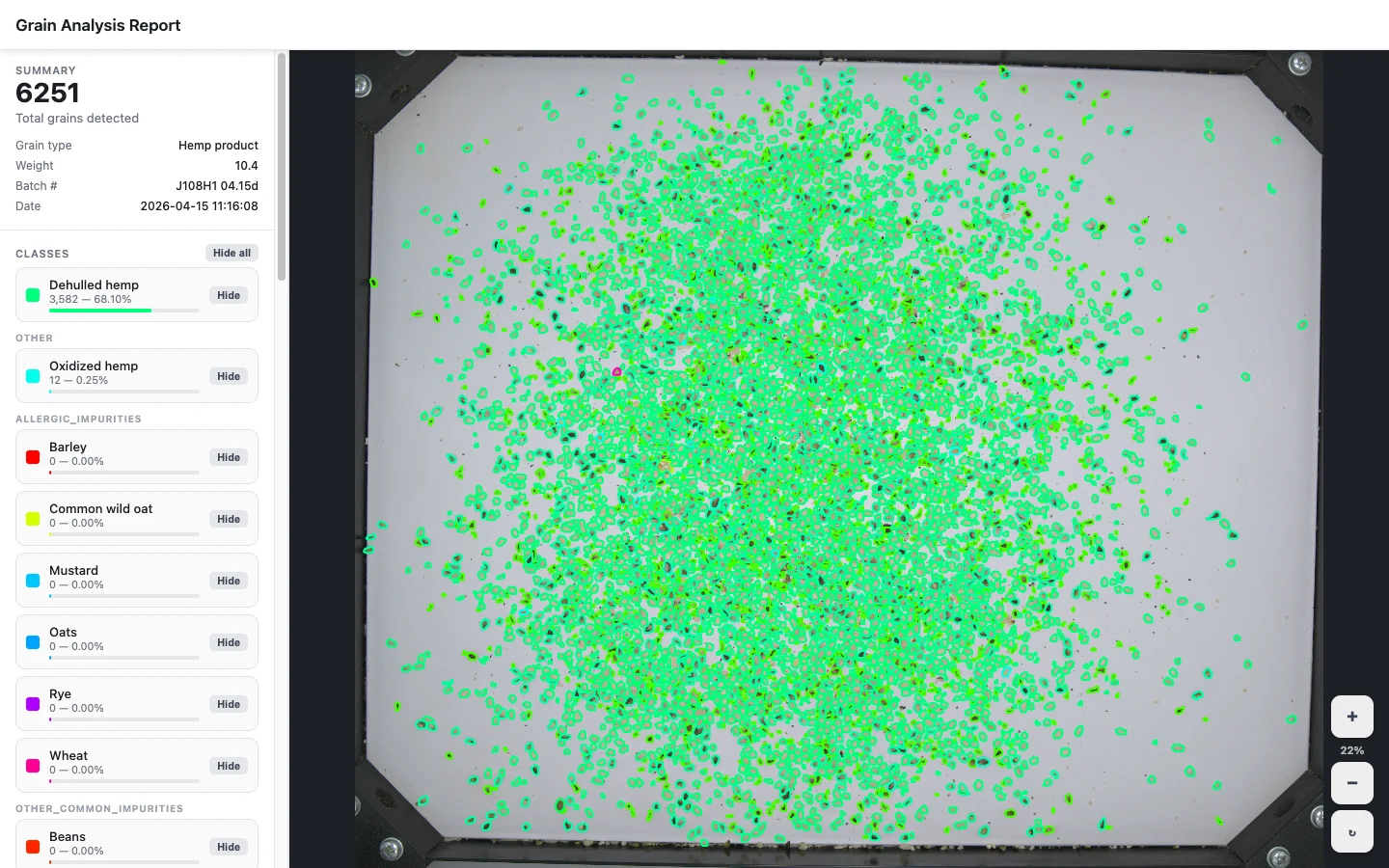 Open interactive report →
One of the most useful features is being able to save the sample photo and re-analyze it later when questions or disputes about quality come up.
- Emilija Nugarienė, Junior Laboratory Manager
Anyone who has run a quality role knows what that is worth. A photo-backed record turns a meeting into a five-minute answer.
From the C-suite: quality as fact
Tadas frames the transformation at a different altitude.
Quality has become a fact, not an opinion.
- Tadas Brazdauskas, Product Compliance Manager
“We work with agricultural raw material, where even an experienced specialist cannot notice everything, especially after many manual analyses. The eyes get tired. The system identifies things we wouldn’t catch with the naked eye, and it produces a digital record of each finding.”
The second shift is timing. Manual QC ran as a report after the fact. AI inspection runs alongside the cleaning line. “Now we can do analysis during the process, every day. When you are producing 500 kg of cleaned raw material per hour, response time is critical. What used to be a slow process is now real-time quality management. Fewer non-conformities, less reprocessing, lower cost.”
Tadas condenses the before-and-after in one line: “We used to work with our eyes. Now we work with data.”
What Allive would tell a peer considering automation
Three things stand out in Tadas’s answer. First, the urgency. Second, the reframing of automation as a direction rather than a purchase. Third, the people side.
If you’re still thinking about it, it’s already late. This isn’t a choice. It’s a direction.
- Tadas Brazdauskas, Product Compliance Manager
“Automation isn’t only about saving time. It changes the nature of the work itself. We removed monotony and gave people more responsibility and more room to grow. That’s a bigger value than efficiency alone - not just productivity, but motivation. Work smart, not hard. The most important thing is to choose a partner who wants to walk this road with you, because then the result isn’t just technology. It’s a real business change.”
Emilija’s read from the lab side is quieter, and lands on the same note:
Tools like this will become an inseparable part of daily work, complementing specialists’ expertise and raising efficiency.
- Emilija Nugarienė, Junior Laboratory Manager
“Technology like this saves significant time, increases the reliability of results, and standardizes them,” she adds.
The distinction matters. At Allive, AI inspection did not replace the lab. It gave the lab a second pair of eyes that never gets tired and always shows its work.
For the hemp industry
Allive’s pilot is one data point, not an industry verdict. But it does put a marker down. For a company supplying premium hemp ingredients into markets that do not tolerate compromise, manual-only quality control is no longer a safe default. Buyer expectations are shifting toward digital evidence per batch, and hemp is following the path that grains took a decade ago.
For the reference side of this story (what impurity classes hemp labs track, which standards apply across EU, US, Canada and Japan, and how to evaluate an AI inspection partner), see our hemp seed quality inspection reference. For the September 2025 background on how this partnership started, see our original announcement. For a broader view of how AI-driven analyzers work, see our grain analyzers explainer and grain purity testing guide.
If you run a hemp operation and want to understand what six months of custom model training could look like for your product, book a 30-minute call, try our ROI calculator to see what replacing manual grading could be worth at your throughput, or open a live sample inspection report to see the kind of digital record Allive now produces on every batch.
Frequently Asked Questions
The pilot ran for six months, from October 2025 to March 2026, with weekly review cycles between Allive’s quality team and GrainODM’s model-training team.
By February 2026, the model reached production-grade accuracy on Allive’s full sample set, covering more than thirty impurity classes. On export-critical impurity types such as oxidized hemp seeds, results consistently match the lab.
A standard manual sample analysis took about 10 to 30 minutes end to end, depending on the sample and including data entry. Edge cases such as sorting and counting green hulls could take up to two hours per sample. With AI inspection, those same checks now return in seconds.
Hemp seed impurities often resemble the seeds themselves in color, shape, and size. Off-the-shelf grain models fail to separate them reliably. Allive trained the GrainODM model on their own impurity library, built up from years of hemp production experience.
Each analyzed sample generates a digital report with the original image, detected impurity categories (allergenic, hazardous, harmful), counts, and a timestamp. Reports can be reopened later to resolve quality disputes or answer audit questions.
Allive’s cleaning line processes around 500 kg of cleaned hemp raw material per hour. AI inspection now supports real-time quality decisions at that throughput.
Yes. GrainODM inspection reports can be exported and integrated with existing LIMS or QMS systems. Integration scope is defined during pilot setup.
A pilot transitions into ongoing production use once accuracy targets are met on the customer’s samples. The model continues to be maintainable, meaning new impurity classes or product lines can be added through additional training cycles, rather than requiring a new tool.
 Live demo
See the AI in action
Run a real sample, no signup.
Try the live demoFollow GrainODM
Grain-tech insights, case studies and product updates.
Follow on LinkedInContinue reading
From Tweezers to Imaging: Grain Impurity Analysis at a GAFTA-Approved Port Laboratory
Case StudiesA GAFTA-Accredited Lab Tested Our AI Against Its Own Technicians. Here's the Review.
Case StudiesAI vs. 5 Lab Technicians: What We Found After 4 Months and 600+ Wheat Tests
Case StudiesManual Wheat Sprout Detection Fails: AI vs. Human Eye
See the AI grade a real grain sample
Run a sample in your browser and watch it flag every impurity. No signup, no sales call.