


Key Takeaways
Hemp seeds aim for ≥99% purity in food-grade markets, with detection of 30+ impurity classes split across allergenic, hazardous, and harmful categories.
Manual hemp seed inspection takes 10 to 30 minutes per sample (up to 2 hours when sorting green hulls). AI vision returns the same analysis in seconds.
Hemp impurities overlap visually with the seeds themselves (Ergot resembles Sclerotium, Ragweed resembles Common wild oat). Off-the-shelf grain models fail on separation; hemp-specific custom training is the fix.
Export markets (EU, US FDA, Canada CFIA, Japan) each impose physical purity and phytosanitary expectations. Quarantine seeds like Ragweed carry zero-tolerance weight.
A 6-month pilot with Allive, one of Europe's largest hemp producers, produced a hemp-specific AI model at 93.25% overall accuracy on 100% production samples across 30+ classes.
Digital inspection reports with per-grain segmentation eliminate buyer disputes and enable audit-ready documentation that can be sent straight to the customer.
Hemp seed is no longer a niche ingredient. Hulled seeds, protein concentrates, and cold-pressed oils supply food, wellness, and supplement brands across the EU, US, Canada, and Japan. As volumes grow, so does the scrutiny on quality. Hemp buyers now ask for documented purity on every batch, not just a certificate of analysis at contract signing.
The inspection methods that service this trade, however, are inherited from commodity grain work. A lab technician spreads a sample, counts impurities by hand, and transcribes the result into a journal. For a standard hemp seed lot this takes 10 to 30 minutes. For a difficult one it can take hours. For a processor scaling into premium export markets, it becomes the constraint on the whole operation.
This reference post covers what hemp seed quality inspection actually involves: what impurities are tracked, how they are grouped, which standards apply in the major export markets, and how modern AI-based detection compares with traditional manual analysis. It draws throughout on a 6-month pilot at JSC Allive, one of Europe’s largest vertically integrated hemp producers, whose lab team trained a hemp-specific AI model from scratch alongside GrainODM engineers. The full story is documented in our Allive case study.
Why hemp seed quality control is different from grain QC
Hemp is not wheat. Three properties make hemp quality inspection harder than its cereal cousins.
Morphology overlap. Hemp seeds are small (typically 3 to 5 mm), irregular in shape, and come in a wide colour range from light tan to dark brown to green. Many of the impurities a hemp lab has to catch sit within the same size, shape, and colour envelope as the seeds themselves. A broken mustard seed, a fragment of ragweed, or a small stone can be mistaken for a hemp kernel in a rushed manual sort.
Category similarity within impurities. Even the impurities resemble each other. Ergot (a toxic fungal body) and Sclerotium (a related fungal resting stage) are visually similar. Common wild oat and Ragweed seeds share silhouettes. A sieve pass does not separate them. A tired pair of eyes at the end of a shift often does not either. Both of these pairs must be detected and counted separately because they carry different regulatory weight.
Market expectation is zero compromise. Hemp seeds feed into products that sit next to almonds, chia, and oat milk on supermarket shelves. The buyer base is risk-averse food brands, not commodity traders. A single ragweed contamination can end a supply relationship. Premium export markets, as Allive’s Product Compliance Manager Tadas Brazdauskas describes them, “do not tolerate compromise, so we do not make any either”.
Hemp inspection therefore combines two pressures that grain inspection rarely sees together: high classification difficulty and zero buyer tolerance for escape. The result is a workflow where either accuracy or throughput gives way. Manual labs tend to preserve accuracy and lose throughput. AI-enabled labs aim to preserve both.
The hemp impurity taxonomy
Most production hemp labs group impurities into three business-relevant categories. The split is not a scientific taxonomy; it is organised around the question “why does this matter if a customer finds it in my sample?”. The categories below reflect the framework Allive’s QC team uses and that we replicated in the GrainODM model.
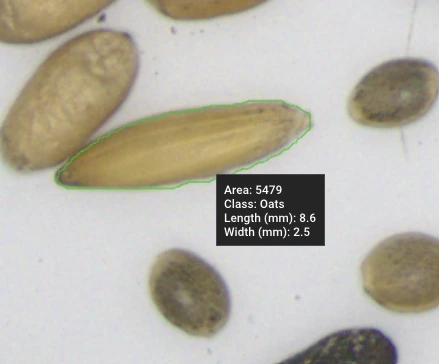
Allergenic impurities
Cereal seeds and grasses that can trigger gluten or cross-contact concerns in food manufacturing.
| Class | Scientific name | Why it matters | Detection difficulty |
|---|---|---|---|
| Oats | Avena sativa | Gluten cross-contact risk for certified gluten-free hemp | Medium |
| Barley | Hordeum vulgare | Gluten allergen | Medium |
| Wheat | Triticum aestivum | Gluten allergen; most common cross-contact source | Medium |
| Rye | Secale cereale | Gluten allergen; Ergot-prone host | Medium |
| Mustard | Sinapis alba / Brassica spp. | Labelled allergen in many jurisdictions | High (small size) |
| Common wild oat | Avena fatua | Gluten cross-contact; easily confused with cultivated oat | High |
| False oat grass | Arrhenatherum elatius | Agronomic contamination; similar silhouette to oat | High |
Hazardous impurities
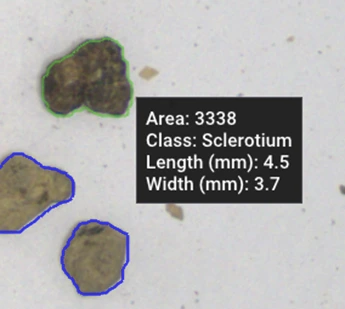
Fungal bodies and toxic seeds that pose direct food-safety and veterinary risk.
| Class | Scientific name | Why it matters | Detection difficulty |
|---|---|---|---|
| Ergot | Claviceps purpurea sclerotia | Toxic alkaloids; strict EU limits. See Ergot in grain. | High |
| Sclerotium | Sclerotinia / Claviceps spp. | Fungal resting bodies; visually similar to Ergot | High |
| Castor seed | Ricinus communis | Contains ricin, a highly toxic protein; zero tolerance in food | Medium |
Harmful and phytosanitary impurities
Weed seeds and agronomic contaminants that are restricted or prohibited under import phytosanitary rules.
| Class | Scientific name | Why it matters | Detection difficulty |
|---|---|---|---|
| Ragweed | Ambrosia artemisiifolia | Quarantine weed; zero tolerance in many markets. See Ragweed inspection. | High |
| Toothed medick | Medicago polymorpha | Spiny pods; restricted in several import regimes | Medium |
| Oilseed radish | Raphanus sativus | Cover-crop escape; common agronomic contaminant | Medium |
| Wild radish | Raphanus raphanistrum | Weed seed; similar size to hemp kernels | High |
| Hairy tare | Vicia hirsuta | Legume weed; multi-coloured seed coat | Medium |
| Galium | Galium aparine | Cleavers; burr-like adherence spreads between lots | Medium |
| Woolly burdock | Arctium tomentosum | Seed-bearing burrs in harvest | Low |
| Pale smartweed | Persicaria lapathifolia | Field weed; triangular seeds can slip through sieves | Medium |
| Cockspur grass | Echinochloa crus-galli | Grass weed; fragmented pieces confuse with hulls | High |
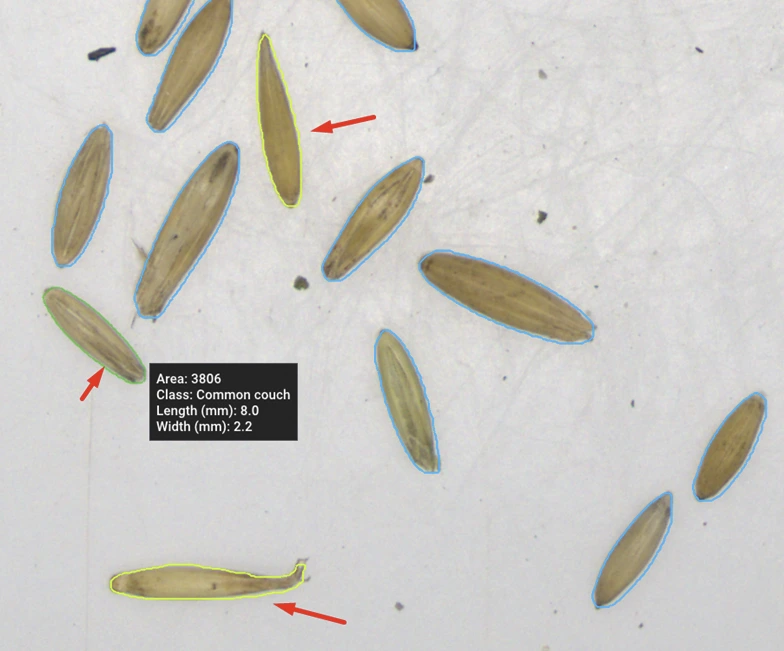
| Common couch | Elytrigia repens | Rhizomatous grass weed; seeds mimic cereal fragments | Medium |
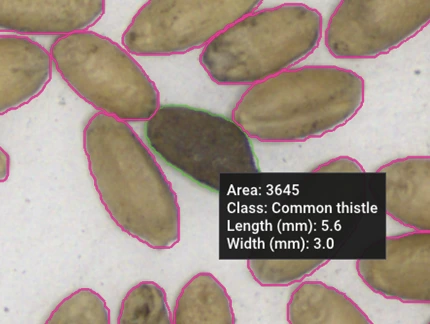
| Common thistle | Cirsium vulgare | Spiny weed; seeds settle with hemp during cleaning | Medium |
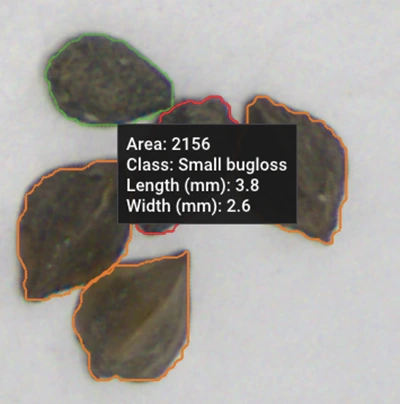
| Small bugloss | Anchusa arvensis | Dark, leaf-shaped seeds; overlaps with oxidised hemp visually | High |
Hemp sub-types inside the crop itself
Beyond foreign material, inspectors also classify the hemp seeds themselves into product sub-types. Each has a different commercial value.
| Sub-type | Description | Commercial signal |
|---|---|---|
| Healthy hemp | Intact, properly ripened hemp seed | Primary product; drives the yield number |
| Dehulled hemp | Hemp kernel separated from its hull (hemp hearts) | Higher-value food-grade product |
| Hemp husk | Outer shell separated during dehulling | By-product; volume indicator for the dehulling line |
| Immature hemp | Unripe or underdeveloped seed | Lower oil content; downgrades the lot |
The sub-type split matters commercially as much as the impurity split. Mis-classifying Healthy hemp as Dehulled hemp (or the reverse) directly affects the yield percentage reported to customers, which in turn affects price and contract compliance.
Manual hemp inspection methods
The traditional hemp inspection workflow has three steps: sieve, sort, record.
Sieve. A sample (typically 10 g) is passed through one or more sieves to separate by size. This removes dust and large debris and splits the remaining material into workable fractions.
Sort. A technician visually classifies each object on a tray against the trained impurity catalogue. Each impurity is counted and weighed individually. On a clean sample this takes about 10 minutes. On a sample with a lot of green hulls or overlapping weed seeds it can take up to two hours.
Record. Results are entered into a journal and, in most operations, copied into a spreadsheet for reporting. Every transcription step introduces an opportunity for error.
At Allive, this workflow ran 20 to 30 samples per day before the AI pilot. The end-to-end time per sample, including data entry, was 10 to 30 minutes for standard cases. Emilija Nugarienė, Allive’s Junior Laboratory Manager, described the pain point directly in the case study interview:
A standard sample took about 10 minutes. But some processes, like sorting and counting green hulls, could take up to two hours.
- Emilija Nugarienė, Junior Laboratory Manager
Manual hemp inspection breaks in three predictable ways as volume grows.
- Fatigue erodes accuracy. After the tenth sample of the day, the eye-brain pipeline gets slower and less discriminating. The impurities hardest to catch (Sclerotium that looks darker than usual, a Cockspur grass fragment shaped like a hull) are the ones that slip through late-shift checks.
- Subjectivity breaks between operators. Two technicians sorting the same sample will rarely produce identical counts. For a buyer querying a batch result, this is a weak foundation.
- Evidence is reconstructed, not recorded. A paper journal plus an Excel summary is not an artefact you can send to a customer who disputes a lot. The lab can describe what it saw. It cannot show it.
These are known limits of manual work and they become acute for hemp specifically because of the morphology overlap described earlier. They also become acute for any processor growing beyond a single shift.
What is manual hemp inspection really costing you?
If your lab runs 20 to 30 hemp samples a day at 10 to 30 minutes each, that is a full FTE just on purity classification. The ROI calculator estimates recoverable lab hours and throughput gains at your own volume.
Try the ROI calculator →Hemp standards and export compliance
Physical purity requirements for hemp seed converge around a common principle across export markets: ≥99% clean hemp, zero tolerance on quarantine weed seeds, and documented phytosanitary and analytical traceability. The specific regulator, terminology, and documentation differ.
| Market | Regulator | Hemp seed food status | Physical purity expectation |
|---|---|---|---|
| EU | EFSA, member-state authorities | Traditional food (not Novel Food for seeds) | Industry target ≥99% purity; phytosanitary zero tolerance on quarantine weeds |
| US | FDA, USDA | GRAS recognition for hulled hemp seeds (2018) | Food ingredient framework; AOAC methods for analysis |
| Canada | Health Canada, CFIA | Permitted food under Industrial Hemp Regulations (2018) | CFIA phytosanitary import rules; physical purity per contract |
| Japan | MHLW | Permitted as food under Food Sanitation Act | Strict import inspection; zero tolerance on quarantine impurities |
Several cross-cutting points matter for hemp exporters regardless of destination.
EU Organic. Hemp sold as organic must comply with EU Regulation (EC) 834/2007 and its successor regulations. Organic claims raise the bar on upstream traceability but do not change physical purity expectations.
Food safety management. FSSC 22000 and ISO 22000 frameworks are common among hemp processors supplying major food brands. Neither sets hemp-specific physical purity limits, but both require documented inspection procedures and traceable records.
Admixture standards for reference. Hemp-specific regulatory text is thinner than the EU Besatz framework (EN 15587) that governs cereals. Producers often use general grain admixture standards as a reference floor, adding hemp-specific impurity categories on top.
Phytosanitary is the highest-stakes category. The quarantine list (Ragweed, Toothed medick, and comparable species per market) is where a single escape can halt a shipment. For hemp exporters, the detection standard here is effectively zero tolerance, which puts pressure on the inspection method itself.
AI-based hemp seed inspection
AI-based inspection replaces the sieve-sort-record workflow with capture-classify-record. The three-step sequence on an AI inspection bench looks like this.
Capture. A calibrated camera under controlled lighting takes a high-resolution image of the sample. Sample placement is standardised (fixed tray, fixed distance) so successive analyses are directly comparable.
Classify. A computer vision model segments each individual object in the image and assigns it a class label (Healthy hemp, Sclerotium, Ragweed, and so on), a probability score, and three geometric measurements (length, width, area). A production-grade hemp model works against 30 or more impurity classes.
Record. The result is written to a structured digital record with the original image, the per-object annotations, the category totals (allergenic, hazardous, harmful), and a timestamp. The record can be reopened weeks later or sent to a customer for independent review.
The critical detail is that a useful hemp model is not a generic grain model with hemp added as one more class. Hemp morphology and impurity overlap require the model to be trained on hemp-specific data, iterated with lab feedback over several months. Allive’s model took six months of weekly review cycles to reach 93.25% overall accuracy across the full class set. In the pilot’s early weeks, impurities that did not cleanly match any trained class collapsed into a catch-all “other seeds” bucket, producing noisy counts. By the end of the pilot, that bucket had been replaced by more than thirty specific classes with stable accuracy.
The case for custom training is worth quoting directly. From Tadas Brazdauskas, Allive’s Product Compliance Manager:
We weren’t looking for technology so much as the brains behind it.
- Tadas Brazdauskas, Product Compliance Manager
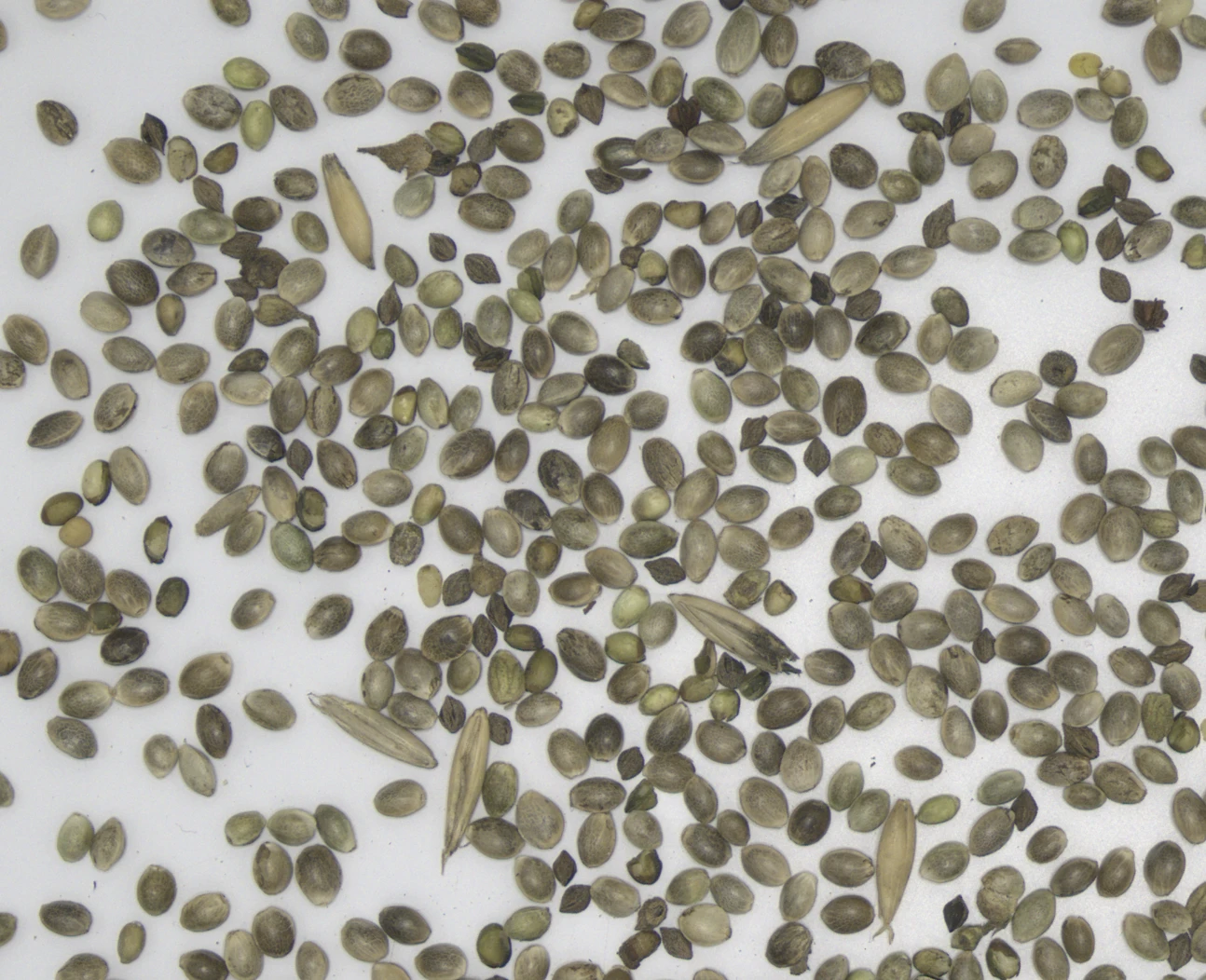
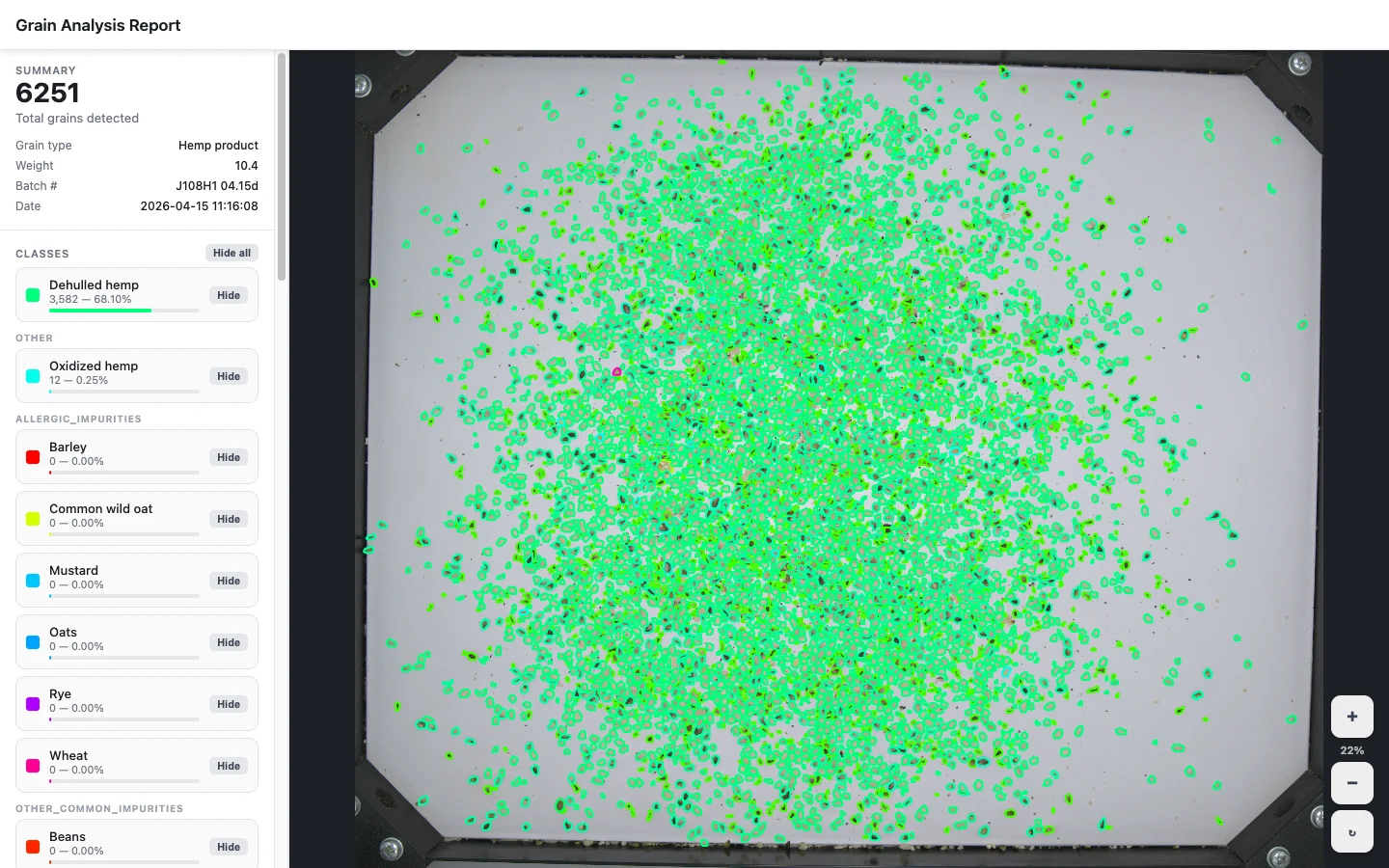
What the system produces on a live sample is easier to understand by looking at it. The screenshot below is a real inspection record from Allive’s production line. Click to open the full interactive report in a modal.
 Open interactive report →
The practical implication of a record like this is that dispute resolution stops being a conversation. When a buyer queries a batch, the producer sends the file. The buyer opens it, inspects any grain, and sees exactly what the lab saw.
For readers new to automated inspection, our grain analyzers explainer covers the broader analyzer category context, and the grain purity test post documents the manual EN 15587 workflow that image-based AI inspection runs alongside.
Manual vs AI hemp inspection at a glance
| Dimension | Manual | AI (custom-trained on hemp) |
|---|---|---|
| Time per sample | 10 to 30 minutes; up to 2 hours for green hulls | Seconds |
| Consistency | Varies with operator, shift, fatigue | Identical classification on every sample |
| Class granularity | Typically 10 to 15 manual categories | 30+ classes plus hemp sub-types |
| Evidence trail | Paper journal plus Excel entry | Digital report with annotated image and per-grain metadata |
| Dispute resolution | Re-run the test (consumes material) | Reopen or send the saved inspection record |
| Phytosanitary catch rate | Dependent on operator experience | Every grain screened against each class |
| Audit readiness | Reconstructed from journals | Timestamped digital record ready on demand |
How to evaluate an AI inspection partner for hemp
Hemp buyers evaluating AI inspection vendors tend to encounter two broad offerings: generic grain models marketed as hemp-capable, and hemp-specific services that train a model on the customer’s own data. The difference is material. Four signals separate the two.
Custom training on your product, not someone else’s. A vendor that cannot or will not train on your samples is selling a grain model, not a hemp service. Ask what the onboarding process looks like. If the answer is “send us a sample, we will run it through our library”, expect weak accuracy on your specific impurity mix.
A documented iteration cadence. Hemp models improve over weekly cycles, not one-off deployments. Ask for the vendor’s review protocol. Weekly joint reviews with documented observations and model changes, as used in the Allive pilot, are the benchmark.
Per-grain auditable outputs. The deliverable should be a per-object record (class, probability, measurements) that you can open later, not a summary statistic. A vendor that shows only category totals has nothing to give a buyer in a dispute.
Integration with existing QMS or LIMS. A hemp-specific model that cannot export its records into your laboratory information or quality management system creates a second, parallel record silo. That slows audits. Ask about integration scope during pilot setup.
A useful heuristic from Allive’s side of the pilot: the partnership was valuable because GrainODM’s team learned their product, not because they sold a finished solution. “We weren’t looking for technology so much as the brains behind it” is the short version. The long version is six months of weekly reviews against real production samples.
Red flags to watch for include vendors who promise hemp accuracy on day one, demos shot against samples the vendor supplied, closed data pipelines that do not export, and pricing models that do not cover ongoing model maintenance after launch.
Real-world example: Allive’s 6-month pilot
Allive ran a six-month structured pilot with GrainODM from October 2025 through March 2026 to replace manual hemp seed grading with custom-trained AI inspection. The pilot produced a hemp-specific model across 30+ impurity classes.
Key numbers from the pilot:
- 93.25% overall accuracy on 100% production samples by February 2026
- 0.03 percentage points gap between AI and laboratory oxidised-hemp-seed measurements across 9 samples (lab 1.54%, system 1.57%)
- 10 to 30 minutes → seconds per standard sample; up to 2 hours → seconds for green hull classification
- 20 to 30 samples per day throughput capacity, at 500 kg per hour production line speed
- 96-page joint review log capturing every week’s observations, model changes, and resolved edge cases
From Tadas Brazdauskas, Allive’s Product Compliance Manager, on the broader shift:
Quality has become a fact, not an opinion.
- Tadas Brazdauskas, Product Compliance Manager
For the full narrative, including the lab-floor perspective from Emilija Nugarienė, the pilot iteration arc, and the partnership decision criteria, read the full Allive case study →. For the September 2025 background on how this partnership started, see the original announcement.
Where to go next
This post is the reference for hemp seed quality inspection across standards, impurities, and methods. Three tracks are worth following from here depending on what you need.
If you want the customer story: the Allive case study covers the 6-month pilot in narrative form, with Tadas’s and Emilija’s direct voice, and an embedded live sample inspection report you can interact with.
If you want to estimate ROI at your own operation: the ROI calculator turns sample count and time per sample into recoverable lab hours and throughput gains.
If you want to discuss hemp-specific model training for your product: book a 30-minute call with our team. We will walk through your current inspection workflow and sketch what a pilot would look like on your samples.
See what a hemp inspection report looks like end to end
Open a live record from Allive's production line: 6,251 grains individually segmented, classes sidebar, hover-to-identify detail, and a shareable interactive record. No signup.
Open the live sample report →Frequently Asked Questions
Hemp seed purity measures the share of intact, viable hemp seeds against foreign matter (weed seeds, broken kernels, hulls, debris, fungal bodies, stones). Industry targets sit at ≥99% purity for food-grade hemp. Poor purity affects nutritional yield, food safety, and brand reputation. For premium export markets, documented purity is a commercial requirement, not a laboratory nicety.
Hemp impurities are typically grouped in three categories. Allergenic impurities include cereals like Oats, Barley, Wheat, Rye, and Common wild oat. Hazardous impurities are fungal bodies such as Ergot and Sclerotium. Harmful (phytosanitary) impurities include quarantine weed seeds like Ragweed, Toothed medick, Oilseed radish, and Hairy tare. Within the hemp crop itself, inspectors also track sub-types: healthy hemp, dehulled hemp, hemp husks, and immature seeds. See the Allive case study for a 30+ class production example.
Premium food-grade hemp programmes converge around ≥99% physical purity, with the remaining fraction split between allergenic, hazardous, and harmful impurity categories. Some retailers and private-label buyers require tighter specifications (99.5%+) with documented per-class caps, particularly zero tolerance on quarantine weed seeds like Ragweed. The threshold always sits downstream of phytosanitary rules enforced by the importing market.
A calibrated camera captures a high-resolution image of the spread sample. A computer vision model segments each object, classifies it against the trained impurity classes, records a probability score, and measures length, width, and area. The output is a digital record per grain that can be opened, sent, and audited later. Hemp-specific accuracy depends on whether the model was trained on hemp impurity data, not just standard grains.
In the EU, hemp seed is traded as a traditional food; member-state authorities and EFSA oversee food safety, with physical-purity expectations of roughly ≥99% for food-grade material. In the US, hulled hemp seeds received FDA GRAS recognition in 2018; AOAC and USDA grain-inspection frameworks govern analysis. In Canada, Health Canada and the CFIA administer the Industrial Hemp Regulations (2018) and import phytosanitary rules. In Japan, hemp seed is permitted as food under the Food Sanitation Act, with strict import inspection for quarantine impurities. Each market enforces zero-tolerance on quarantine weed seeds like Ragweed.
Standard grain AI models are trained primarily on wheat, maize, barley, and oats. Hemp introduces small, irregular seeds with colour ranges from light tan to dark green, and impurities that mimic the seeds themselves (Ergot resembles Sclerotium; Ragweed resembles Common wild oat). Generic models either force these into wrong classes or dump them into a catch-all ‘other seeds’ bucket with poor accuracy. A hemp-capable model has to be trained on hemp-specific imagery over several months, with lab feedback closing the loop on edge cases.
Every analyzed sample keeps its high-resolution image and a full interactive record with per-grain class, measurement, and probability. When a buyer or auditor disputes a batch, the producer sends them the file. They open it, zoom into any object, and see exactly what the lab saw. The conversation moves from subjective judgement to a shared artifact. Allive uses this routinely on export batches.
Look for four signals. First, the partner should train a custom model on your product rather than offer a fixed library. Second, they should work in short iteration cycles (weekly is a healthy cadence) with documented change logs. Third, they should produce auditable outputs with per-grain records, not just aggregate statistics. Fourth, they should integrate with your existing LIMS/QMS or at least export standard digital records. Avoid vendors that promise hemp-ready accuracy on day one without seeing your samples.
 Live demo
See the AI in action
Run a real sample, no signup.
Try the live demoFollow GrainODM
Grain-tech insights, case studies and product updates.
Follow on LinkedInContinue reading
See the AI grade a real grain sample
Run a sample in your browser and watch it flag every impurity. No signup, no sales call.