


Key Takeaways
Ergot alkaloids are heat-stable toxins that survive milling and baking - a visually clean load can still fail chemical testing downstream.
EU limits for wheat flour (100 µg/kg) and rye milling (500 µg/kg) are set to be halved by 2028, making current detection protocols already insufficient for tomorrow's market.
A single contaminated truckload entering a silo can trigger facility-wide cross-contamination, turning one delivery into a multi-batch crisis worth hundreds of thousands of euros.
Manual ergot picking takes 30 minutes per sample and misses small, broken sclerotia fragments - the exact fragments with the highest alkaloid concentrations.
GrainODM AI inspection delivers a full ergot report in 3 seconds with 99.8% accuracy, generating a digital traceable record before the truck unloads.
A Growing Liability at the Intake Gate
The global grain trade has entered a period of unprecedented quality scrutiny. Claviceps purpurea, the fungal pathogen responsible for ergot, has moved from a historical footnote to a primary financial risk for elevators, millers, and exporters. Driven by shifting climatic patterns and a tightening web of safety regulations, the presence of ergot in a delivery is no longer just a grading deduction -it is a high-stakes liability that can lead to multi-million dollar product recalls and total loss of market access.
Recent enforcement actions make the stakes concrete. A high-profile “Serious” RASFF alert was issued in January 2026 for a shipment of Dutch wheat that tested at 921 mg/kg of ergot alkaloids - 4.6× over the 200 mg/kg permitted maximum for raw wheat grain. For grain handlers, this is the critical lesson: by the time ergot is detected in a processing line or finished flour, the financial damage is already done.
The Biology of the Threat: Why Visual Checks Fail
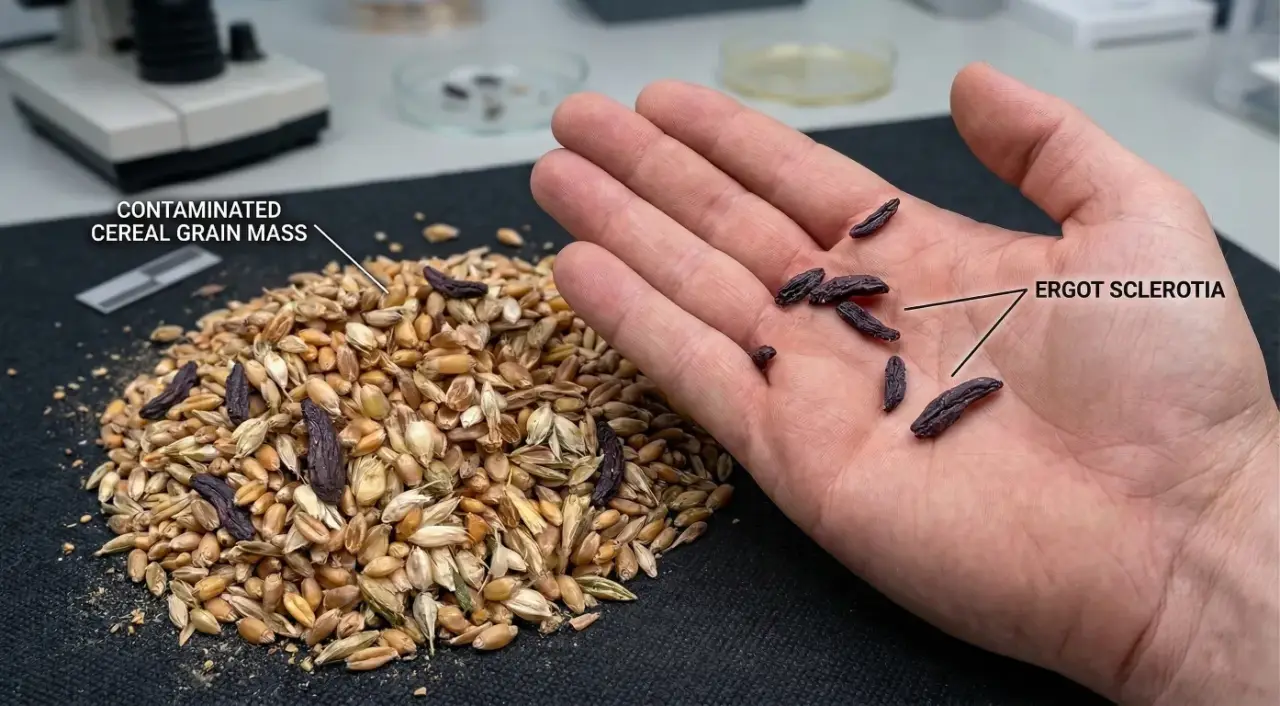
Ergot is a fungus that replaces healthy grain kernels with dark, hardened masses called sclerotia. While rye remains the most susceptible host, ergot incidence has risen significantly in wheat, barley, and triticale in recent seasons (FWI research) due to climate-driven shifts in growing conditions.
The danger lies in ergot alkaloids - toxic biogenic amines produced within the sclerotia (R-Biopharm). These toxins are remarkably stable, surviving the heat of milling and baking to pose a serious risk to both human and animal health. Ergot is not the only fungal threat of this kind - Fusarium mycotoxins follow a similar pattern of mycotoxin contamination affecting European cereals at scale.
Why Manual Inspection Misses Ergot
Traditional intake protocols rely on manual sample picking, where a technician visually inspects a 100g sample. Ergot sclerotia are visible - dark, hardened bodies that stand out against clean grain. The problem is not visibility; it is the limits of human inspection under real-world intake conditions.
-
Small and broken fragments. Grassweed ergot produces sclerotia that are smaller and more fragile than those found in wheat (FWI research). These fragment during harvest and transport into pieces that are easy to overlook when working quickly through dozens of samples under harvest pressure. Critically, these small fragments carry the highest alkaloid concentrations per gram.
-
Speed and fatigue. A thorough ergot inspection can take up to 30 minutes per sample. Intake throughput rarely allows for that. Faster inspection means more missed fragments - and the fragments most likely to be missed are the smallest and most concentrated.
Once a contaminated load enters the silo, alkaloids transfer from broken sclerotia to surrounding clean grain through direct contact, turning a single delivery into a batch-wide problem that cannot be reversed by visual inspection. The intake gate is the only point where this can be prevented.
The Regulatory Squeeze: Global Standards in 2026
The regulatory environment is defined by a major divergence between physical and chemical standards. North American systems use weight-based thresholds, while the European Union has moved to strict chemical limits for the sum of the 12 primary ergot alkaloids. For a broader look at how EU and North American grain standards diverge across all contaminant types, see our EU vs USA grain admixture standards comparison.
| Region / Product Type | Current Limit | 2028 Limit | Basis |
|---|---|---|---|
| USA (FGIS) Wheat | > 0.05% by weight | - | Visual / Weight |
| Canada (CGC) Rye | > 0.10% by weight | - | Visual / Weight |
| EU Wheat Flour | 100 µg/kg | 50 µg/kg ↓ | Total Alkaloids |
| EU Rye Milling | 500 µg/kg | 250 µg/kg ↓ | Total Alkaloids |
| Infant Food (EU) | 20 µg/kg | - | Total Alkaloids |
With EU limits for wheat flour and rye milling set to be halved by 2028, operations that are currently compliant will need to significantly tighten their detection accuracy to retain market access. The trajectory is clear: chemical limits will only get stricter.
The Financial Fallout: The Cost of Under-Detection
Missing ergot at the intake point is a high-stakes gamble. Once a contaminated truckload enters a silo, it risks cross-contaminating the entire batch - turning a single delivery into a facility-wide crisis.
1. Direct Load Rejections and Cleaning
In North America, a truckload exceeding the ergot threshold is rejected at the terminal and sent back for specialized cleaning. Professional ergot cleaning currently runs 75 to 85 cents per bushel. Combined with double freight costs, a single rejection can wipe out the profit margin for an entire field.
2. Grade Downgrades and Price Dockage
Ergot is a leading cause of grain downgrading. Moving from a Number 1 milling grade to Feed or Sample grade costs $1.00 to $2.00 per bushel. Standard price discounts for ergoty wheat range from $0.05 to $0.15 per bushel (USDA schedule) before full dockage is even applied.
3. Recall Liability and Legal Penalties
The most severe costs occur post-milling, when contaminated grain has already been processed and distributed:
- The Netherlands (January 2026): A wheat grain shipment tested at 921 mg/kg of ergot alkaloids - 4.6× over the permitted maximum for raw grain (RASFF #821723). The load had already entered the supply chain before detection.
- Livestock operations: Ergot alkaloids cause agalactia (milk failure) and reproductive failure in breeding animals (Merck Vet Manual), leading to significant neonatal mortality in swine and horse operations.
Is your operation ready for the 2028 limit change?
EU wheat flour limits drop to 50 µg/kg in 2028. Operations still relying on manual picking will face recalls, grade downgrades, and lost export contracts - often before they realise the protocol is already insufficient.
Book a free demo →Why Manual Inspection is the Weakest Link
Despite these stakes, most operations still rely on manual sample picking - a process that fails on three fundamental levels. The pattern is consistent across grain defects: manual wheat sprout detection shows the same blind spots that appear with ergot fragments.
- Slow: A thorough manual ergot inspection can take up to 30 minutes per sample, creating a bottleneck at the intake gate during peak harvest throughput.
- Subjective: Fatigue and visual boredom cause technicians to miss small or broken ergot fragments - precisely the fragments with the highest alkaloid concentrations per gram.
- Inconsistent: Different operators grade the same load differently, creating disputes between buyers and sellers that are costly to resolve without objective digital records.
The GrainODM Solution: Ergot Detection in 3 Seconds
GrainODM replaces manual inspection with AI-driven precision at the point of delivery, generating an objective digital report before the truck unloads.
- Speed: GrainODM delivers a full impurity report in 3 seconds - making the process 600× faster than manual methods.
- Accuracy: With 99.8% detection accuracy, the AI identifies ergot bodies and fragments that manual inspection consistently misses, ensuring every load meets current and future regulatory standards. This accuracy has been independently validated - see AI vs. 5 lab technicians across 600+ wheat tests.
- Traceability: Every test produces a digital, time-stamped report that eliminates grading disputes and provides contract-proof documentation for both elevators and producers.
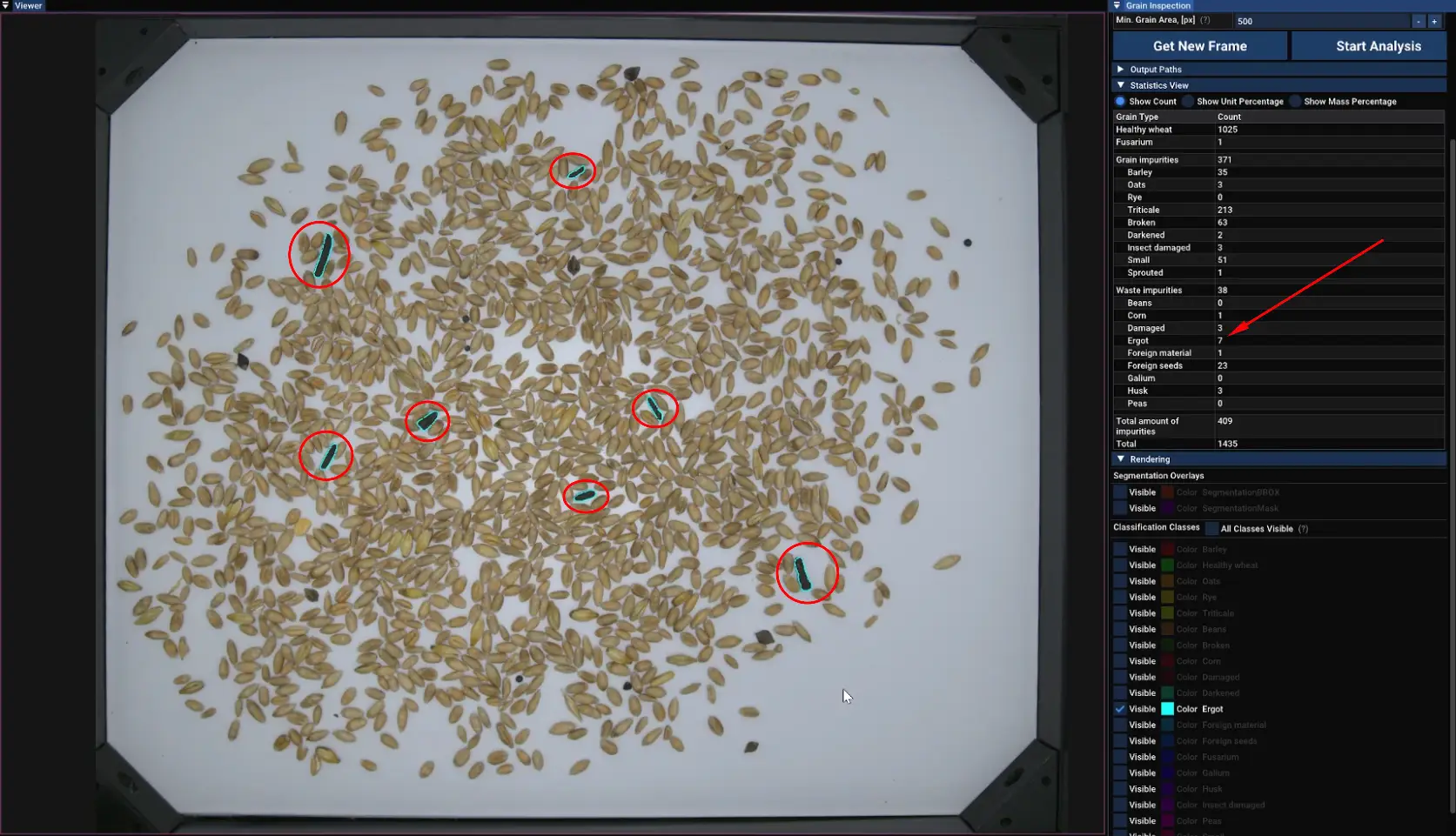
GrainODM AI software detecting ergot sclerotia in a 100g grain sample. Click to enlarge.
Watch GrainODM detect ergot in a 100g sample in real-time.
Want to see this running at your intake gate? Book a 30-minute call and we'll walk through what AI ergot detection looks like for your specific volume and grain type.
Conclusion: Act Before the 2028 Limits Arrive
EU ergot alkaloid limits for wheat flour will halve to 50 µg/kg by 2028. Operations running on manual picking today are already operating at the edge of tomorrow’s compliance threshold - and a single contaminated batch can wipe out the margin on an entire season.
The operations that retain milling-grade contracts in 2028 will be the ones that upgraded their ergot alkaloid detection before the deadline, not after a recall forced their hand. You cannot dispute a RASFF notice with a handwritten grading sheet.
If you want to see what AI-powered ergot detection looks like at your intake gate - including speed, traceability, and what changes at the contract level - book a 30-minute call with our team. No obligation, no pitch deck - just a direct look at the system.
Frequently Asked Questions
Ergot alkaloids are toxic compounds produced by the fungus Claviceps purpurea inside sclerotia - dark, hardened bodies that replace healthy grain kernels. They cause vasoconstriction, neurological disorders, and reproductive failure in humans and livestock. Critically, they are heat-stable and survive milling and baking, meaning contamination in raw grain translates directly to contamination in finished flour and feed.
As of 2026, the EU sets a limit of 100 µg/kg (sum of 12 ergot alkaloids) for wheat flour and 500 µg/kg for rye milling grain. Both limits are scheduled to be halved by 2028 - to 50 µg/kg for wheat flour and 250 µg/kg for rye milling. Infant food is held to 20 µg/kg.
Ergot sclerotia are visible - the problem is that grassweed ergot produces sclerotia that are smaller and more fragile than those found in wheat, fragmenting during harvest and transport into pieces that are easy to overlook under the time pressure of a busy intake gate. A technician working quickly through dozens of samples will consistently miss these small, broken fragments - yet those fragments carry the highest alkaloid concentrations per gram. A properly executed manual ergot inspection takes approximately 30 minutes per sample, time that is rarely available at intake speed.
Costs accumulate at every stage: professional ergot cleaning runs 75-85 cents per bushel; downgrading from milling grade to feed grade costs $1.00-$2.00 per bushel; post-milling recalls can run into millions with full liability exposure. Cross-contamination of a silo multiplies costs across the entire stored batch.
GrainODM uses AI vision to analyse a 100g grain sample in 3 seconds, identifying ergot sclerotia and fragments with 99.8% accuracy. Every test produces a digital, traceable report that can serve as contract-proof documentation for both the receiving elevator and the delivering producer.
 Live demo
See the AI in action
Run a real sample, no signup.
Try the live demoFollow GrainODM
Grain-tech insights, case studies and product updates.
Follow on LinkedInContinue reading
Ragweed (Ambrosia) Contamination in Grain Trade: How One Seed Can Cost Millions
NewsInnovation in Agriculture Industry: How European AgTech is Transforming Farming
CompanyGrainODM at the Grain Processing and Baking Conference 2026 in Sopot
GuidesGrain Quality Disputes at Intake: How Objective Visual Evidence Ends the Argument
See the AI grade a real grain sample
Run a sample in your browser and watch it flag every impurity. No signup, no sales call.