


Key Takeaways
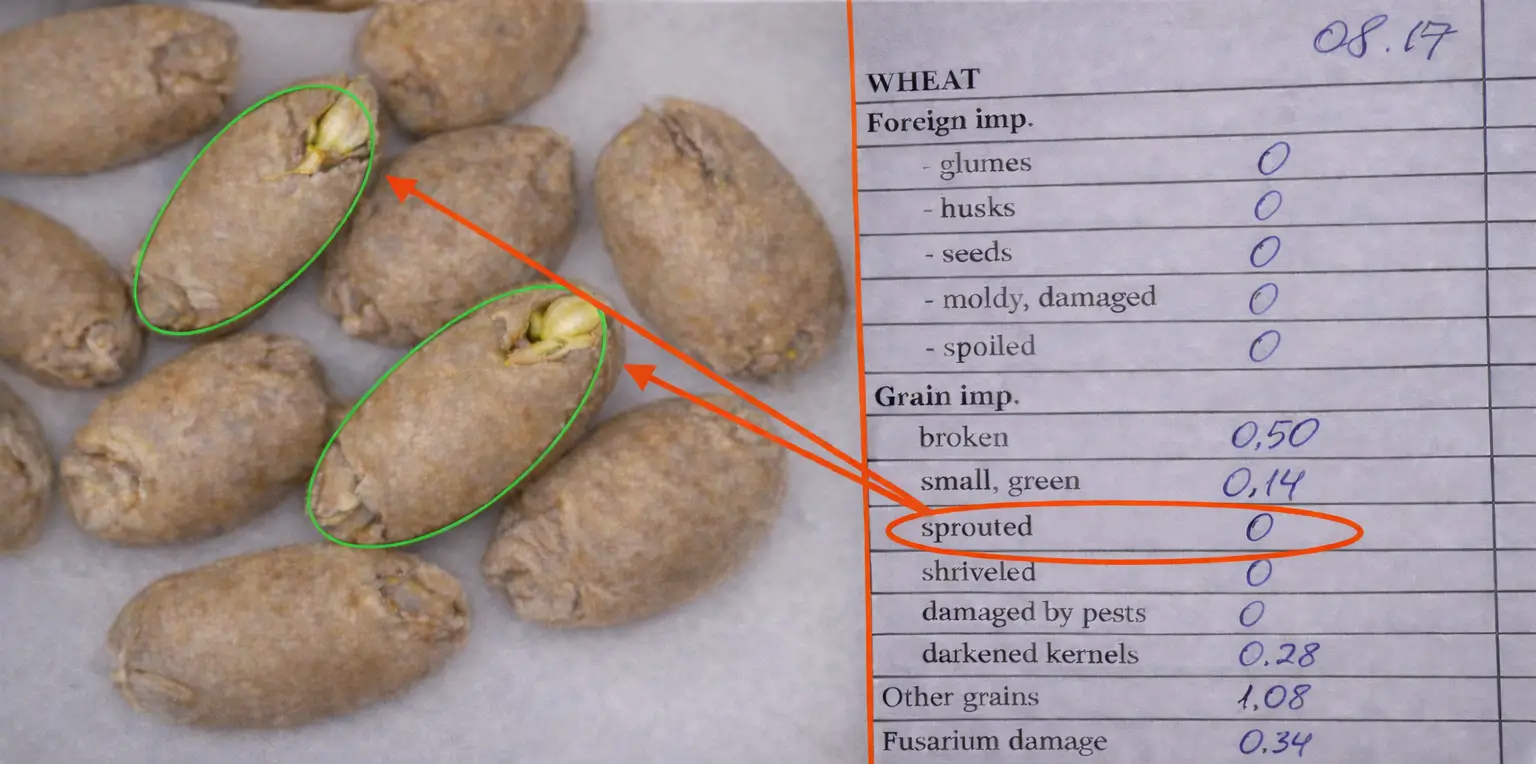
Manual laboratory inspection reported 0% sprouted kernels, while AI detected 1.05% - a critical threshold that can impact Falling Number and grain classification.
Even 1% of sprouted wheat kernels can drop Falling Number from 300 seconds to 220 seconds, potentially downgrading premium milling wheat to feed grade.
Human visual inspection misses subtle germ swelling - the earliest stage of sprouting - which AI systems detect with consistent accuracy.
Sprouted wheat has higher respiration rates, increasing the risk of hot spots and spoilage in storage silos if not properly identified and managed.
AI-powered detection provides visual evidence with bounding boxes, enabling dispute resolution and objective quality documentation.
In the high-stakes world of wheat procurement, the difference between a premium milling grade and a discounted feed grade often comes down to a few millimeters of growth. Wheat sprout detection is one of the most contentious points of negotiation at the intake pit. For laboratory technicians, it is a race against time to manually count damaged kernels; for the seller, it is a matter of significant financial impact.
This case study examines a real-world scenario where traditional laboratory methods failed to identify sprout damage, whereas the GrainODM artificial intelligence system provided a precise, objective analysis.
The Hidden Threat of Pre-Harvest Sprouting (PHS) in Wheat
When wheat is exposed to wet conditions just before harvest, the grain begins the germination process while still in the ear. This is known as Pre-Harvest Sprouting (PHS). From a biological standpoint, the grain is preparing to grow, but from a commercial standpoint, its milling value is plummeting.
The primary issue is the activation of alpha-amylase, an enzyme that breaks down starch into simple sugars. While this is necessary for a growing plant, it is disastrous for the baking industry. Flour made from sprouted wheat produces sticky dough that fails to rise, resulting in poor loaf volume and a dark, gummy crumb.
The Standard Industry Metrics for Wheat
Grain elevators primarily use two methods to manage this risk:
Visual Wheat Sprout Detection: Counting the percentage of kernels showing physical signs of germination (cracked coats, swollen germs, or shoots).
Falling Number (Hagberg) Test: A rheological test measuring the time it takes for a stirrer to fall through a heated wheat flour-water slurry.
Case Study: The Cost of a 1% Oversight
In a recent comparative analysis of a wheat sample, a significant discrepancy was discovered between manual laboratory results and AI-driven analysis.
The Laboratory Report
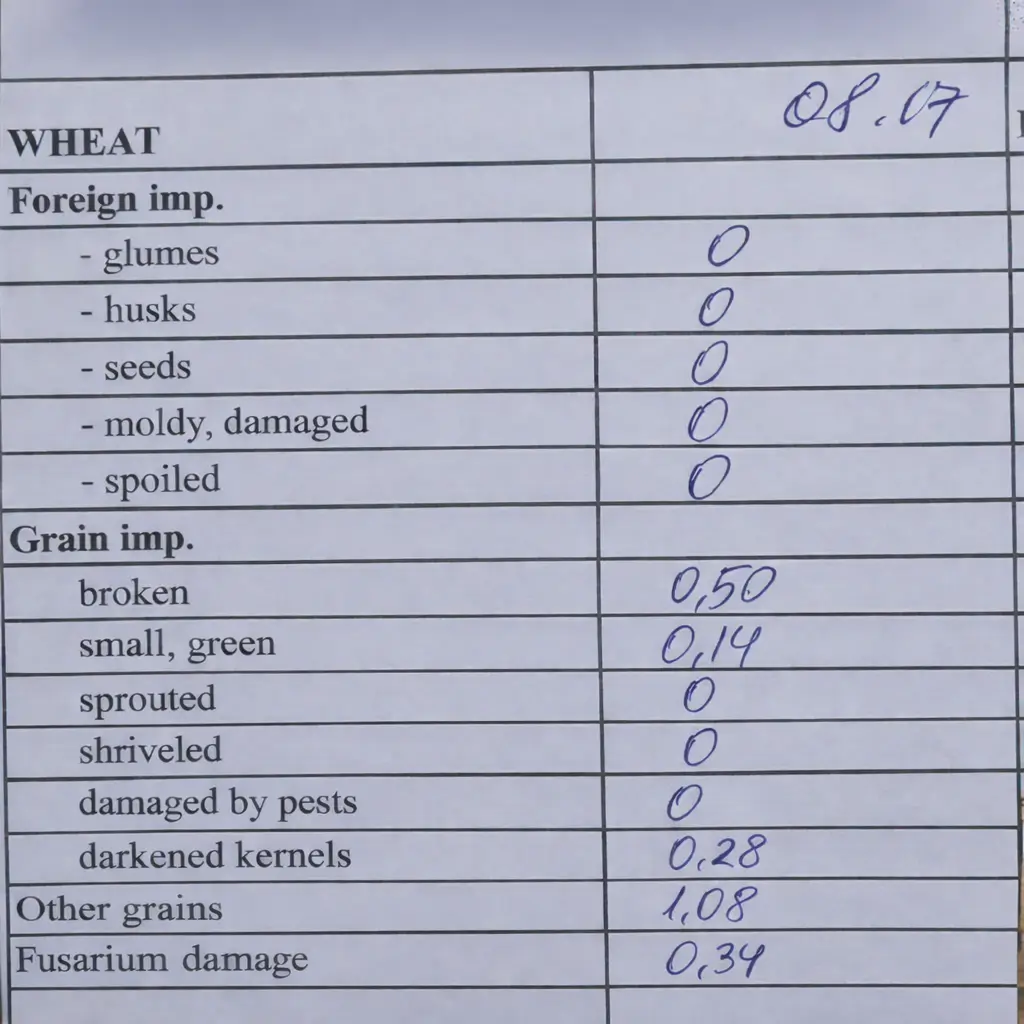
The official laboratory report for this wheat sample indicated:
- Sprouted kernels: 0
- Broken kernels: 0.50
- Shrunken/Green: 0.14
- Darkened: 0.28
- Other grains: 1.08
- Fusarium: 0.34
Based on this report, the load would be classified as “clean” regarding sprout damage, likely securing a top-tier milling classification (Extra or Grade I).
The GrainODM Findings
Simultaneously, the same sample was processed through the GrainODM system. The results told a far more accurate story:
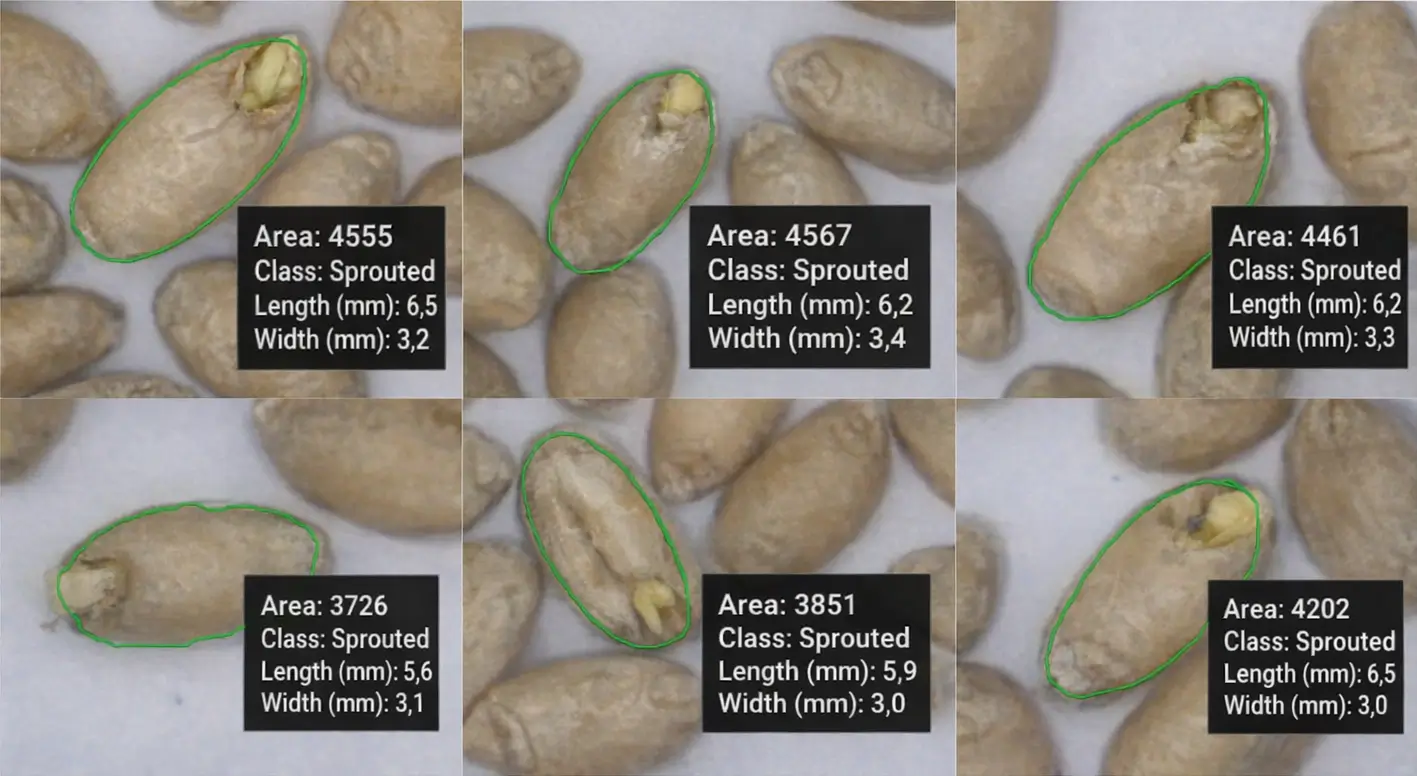
GrainODM Detection: 1.05% Sprouted Wheat
Identification: The system identified specific wheat kernels where the germ had begun to swell or break the pericarp - the very earliest stages of sprouting.
Why Manual Wheat Sprout Detection Misses the 1.05% Threshold
Why did a trained laboratory technician record a zero while the AI detected over one percent? It comes down to the limitations of human perception in a high-pressure intake environment.
The “Micro-Sprout” Trap: As seen in the GrainODM analysis, the detected kernels do not always have long green shoots. Instead, they exhibit subtle germ swelling. Under the fluorescent lights of a busy laboratory, these are easily mistaken for sound wheat kernels.
Sample Fatigue: During the peak of harvest, a technician may process dozens of trucks per hour. Identifying a 1.05% impurity requires meticulously checking every single kernel in a sample. Human eyes naturally glaze over, leading to under-reporting of damaged wheat.
Lack of Standardization: One technician might classify a wheat kernel with a slight germ swelling as “sound,” while another might call it “sprouted.” This lack of objective wheat sprout detection creates friction between the buyer and the seller.
The Economic Consequences of Under-Detection in Wheat
In the wheat industry, the difference between 0% and 1.05% is not a rounding error - it is a massive financial risk for the elevator.
1. The Falling Number Cliff
There is a direct, non-linear correlation between the percentage of sprouted wheat kernels and the Falling Number (FN). Even 1% of sprouted kernels can contain enough alpha-amylase to drop a Falling Number from a stable 300 seconds to a marginal 220 seconds. If an elevator accepts multiple loads with “0% reported” sprouting that actually contains >1%, the combined effect in the storage silo can ruin thousands of tons of milling-grade wheat.
2. Silo Management and Stability
Sprouted wheat grains have higher respiration rates. Even at lower moisture levels, these grains generate more heat and CO2, increasing the risk of “hot spots” in the bin. If an elevator manager relies on an inaccurate “0% sprouting” report, they may fail to prioritize the aeration of that specific bin, leading to total spoilage. Proper storage management is critical, as other factors like wheat weevil infestation can also compromise grain quality during storage.
GrainODM: Automating Wheat Sprout Detection
GrainODM removes the guesswork from the intake process by utilizing high-resolution computer vision and deep learning models specifically trained on wheat morphology and damage patterns.
Features of the GrainODM Solution:
-
Visual Evidence: Unlike a handwritten number on a lab slip, GrainODM provides a digital image of every detected sprouted wheat kernel, highlighted with bounding boxes.
-
Unbiased Accuracy: The AI treats every sample with the same level of scrutiny, ensuring that a 1.05% sprouting rate is detected every single time, regardless of how busy the elevator is.
-
Data Integration: The system provides length and width measurements for each kernel, allowing for advanced wheat profiling that goes beyond simple counting.
-
Dispute Resolution: When a seller questions a discount, the laboratory can present the GrainODM visual report. It is much harder to argue with a high-resolution photo than with a subjective opinion.
For a broader validation of AI against multiple lab technicians across 18 defect categories and 600+ wheat tests, see AI vs. 5 Lab Technicians: What We Found.
Conclusion: Bridging the Gap in Wheat Grading
The transition from manual visual inspection to AI-driven analysis is about transparency and profit protection. As this case proves, the human eye is remarkably good at missing the “quiet” start of a sprout in wheat.
For elevators, GrainODM acts as a safeguard against silo degradation. For farmers, it provides a fair, objective assessment. In an industry where wheat quality is everything, leaving sprout detection to chance is no longer a viable strategy.
Frequently Asked Questions
Even 1% of sprouted kernels can contain enough alpha-amylase to drop Falling Number from a stable 300 seconds to a marginal 220 seconds. This can downgrade premium milling wheat to feed grade, resulting in significant financial losses. Additionally, sprouted wheat has higher respiration rates, increasing storage risks.
AI systems use high-resolution computer vision and deep learning models trained specifically on wheat morphology and damage patterns. They can identify subtle germ swelling - the earliest stage of sprouting - that human eyes might overlook. The system provides visual evidence with bounding boxes around each detected kernel.
Pre-Harvest Sprouting occurs when wheat is exposed to wet conditions just before harvest, causing the grain to begin germination while still in the ear. This activates alpha-amylase, an enzyme that breaks down starch into sugars. While necessary for plant growth, this is disastrous for baking - flour from sprouted wheat produces sticky dough that fails to rise.
GrainODM uses AI-powered computer vision to automatically detect sprouted wheat kernels in 3-20 seconds with high accuracy. Unlike manual inspection, it provides visual evidence with digital images of every detected kernel, ensures consistent results regardless of operator fatigue, and generates traceable reports for dispute resolution.
The New Standard in Grain Purity Analysis
Data, not guesswork. Learn how GrainODM sets a new benchmark for digital grain inspection.