


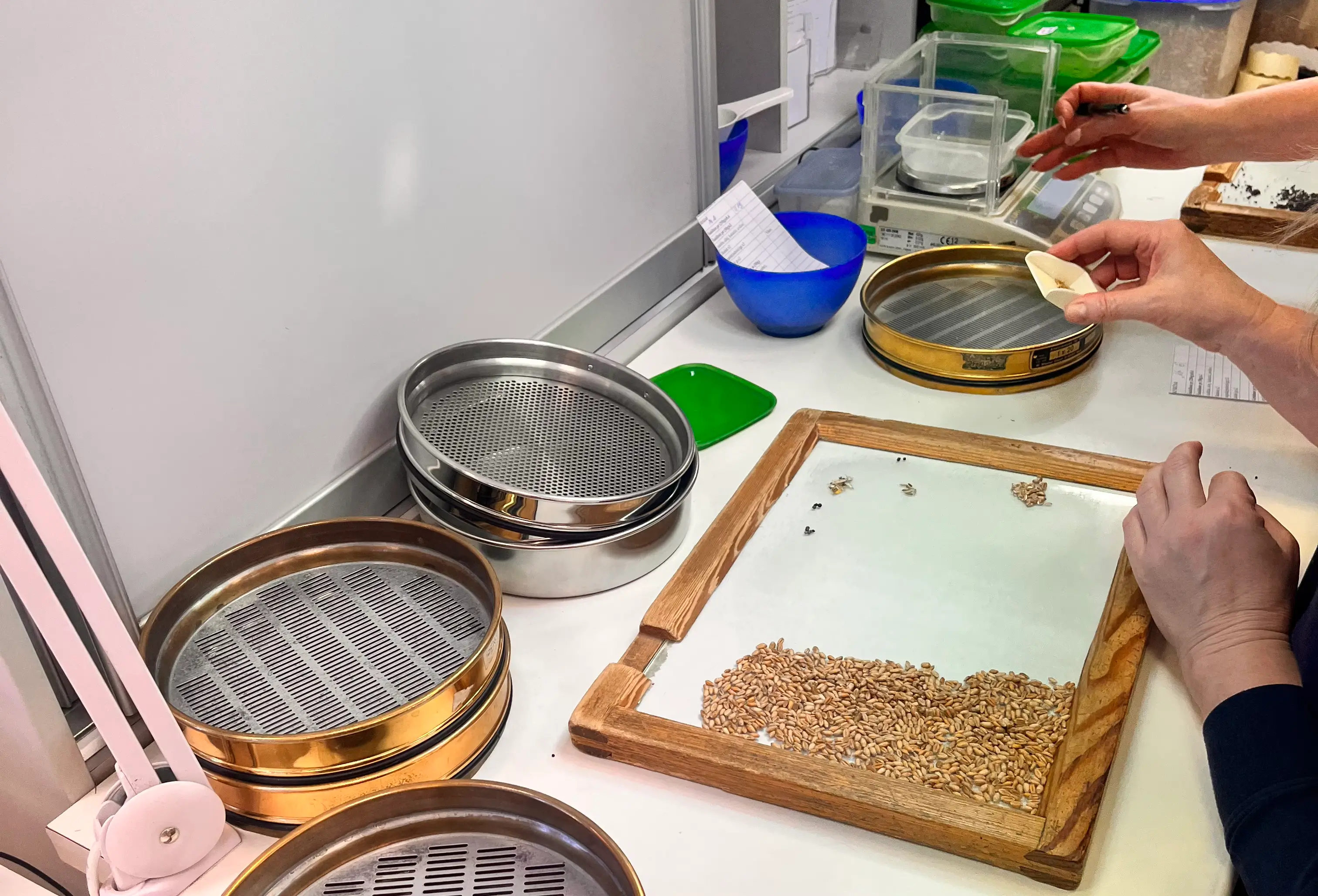
Key Takeaways
European EN 15587 defines Besatz as unified impurities with ~3% total limit in wheat, while USA separates dockage (non-grade affecting) from foreign material (0.4% limit for U.S. No. 1).
EU focuses on food safety with strict ergot limits (0.02% for most cereals, 0.2% for rye), while US emphasizes trade quality through grade classification.
Codex Alimentarius provides compromise standards (1.5% extraneous matter) between EU's 3% tolerance and US No. 1's stricter requirements for international trade.
EU maintains 0.9% GMO adventitious presence threshold versus US's more lenient approach, creating significant trade barriers for non-GMO identity preservation.
Non-compliance costs €20-50 per tonne in quality downgrades, plus potential shipment rejection and contract penalties in cross-border trade.
2025 regulatory updates include EU ergot tightening (now 0.2 g/kg for rye) and US Grain Standards Act reauthorization modernizing inspection procedures.
In international grain trade, regulatory standards determine market access, pricing, and legal compliance. Grain admixture regulations-governing what foreign material is acceptable in cereal shipments-vary dramatically between Europe and the United States, creating complexity for traders, processors, and exporters navigating cross-border transactions.
Understanding these regulatory differences is essential for compliance and profitability. This comprehensive guide compares European Besatz standards (EN 15587) with US FGIS dockage systems, examines international harmonization efforts through Codex Alimentarius, and provides practical guidance for grain professionals managing multi-jurisdiction operations. Whether negotiating international contracts or ensuring regulatory compliance, this analysis clarifies how different standards impact grain quality requirements and trade specifications.
Understanding Admixture: Europe vs USA
The European Approach: Besatz
At the heart of European grain quality control lies EN 15587:2018, the standardized method for determining “Besatz” (impurities) in cereals. This standard defines Besatz as “all matter of a sample of grain other than the basic cereal of unimpaired quality” and applies to common wheat, durum wheat, rye, triticale, and feed barley.
European standards break down Besatz into four principal fractions:
1. Broken grains – fragments of the primary cereal
2. Grain impurities, including:
- Shriveled grains
- Other cereals (e.g., barley in wheat)
- Pest-damaged grains
- Grains with discolored germs
- Heat-damaged grains
3. Sprouted grains – germinated kernels that affect baking quality
4. Miscellaneous impurities (Schwarzbesatz), including:
- Weed seeds
- Ergot sclerotia
- Stones and soil
- Plant debris and husks
- Impurities of animal origin
Some weed seeds, such as ragweed (Ambrosia), are subject to quarantine or near-zero tolerance in many markets and can trigger port detention or cargo rejection.
Typical European standards allow approximately 3% total admixture in wheat, with sub-limits: roughly 2% for grain impurities and 1% for miscellaneous impurities. Critically, ergot sclerotia are limited to just 0.02% (0.2 g/kg) in most cereals, with even stricter limits coming into force.
The American System: Dockage and Foreign Material
The United States takes a different approach under the U.S. Grain Standards Act, administered by USDA’s Federal Grain Inspection Service (FGIS). The American system distinguishes between:
Dockage: All matter that can be removed by approved devices (like the Carter Dockage Tester), including underdeveloped kernels and easily removable debris. Dockage is subtracted from weight but doesn’t count toward grade defects.
Foreign Material (FM): Everything that remains after dockage removal, including broken kernels, weed seeds, and other impurities. This directly impacts the grade.
U.S. wheat grades range from No. 1 (premium) to No. 5 (lowest acceptable), with foreign material limits spanning from 0.4% (No. 1) to 5.0% (No. 5). The system also includes strict count-based limits for hazardous materials like stones, glass, and toxic seeds.
Key Differences
| Aspect | Europe (EN 15587) | USA (USGSA) |
|---|---|---|
| Core concept | Besatz (unified impurities) | Dockage + Foreign Material (separated) |
| Grade impact | Contract-specific limits on Besatz fractions | Official grade determined by FM + damaged + broken kernels |
| Top-grade tolerance | ~3% total Besatz typical | 0.4% foreign material (U.S. No. 1) |
| Toxic seeds | Part of Schwarzbesatz with separate food law limits | Count-based limits per kg |
| Regulatory focus | Food safety and purity | Trade quality and grading |
Regulatory Compliance and Testing Requirements
Official Reference Methods
Both European and US standards specify official reference procedures for admixture determination, which serve as the legal basis for contractual disputes and regulatory enforcement:
European Requirements: EN 15587 mandates representative sampling following GAFTA 124 rules, mechanical sieving with ISO 5223-compliant sieves, and manual classification. Minimum sample masses range from 250g-1kg, with larger samples mandatory for ergot analysis. Results must be reported to 0.1% precision.
US Requirements: FGIS protocols specify approved dockage testers (Carter Dockage Tester) and procedures for foreign material determination. Unlike Europe’s unified Besatz approach, the US separates easily removable dockage from grade-affecting foreign material.
Economic Implications: Non-compliance costs €20-50 per tonne in quality downgrades, plus potential shipment rejection and contract penalties. Manual reference analysis costs €30-80 per sample, though automated methods are increasingly accepted for routine compliance monitoring where correlation with reference methods has been established.
Mycotoxin Connection: Admixture standards intersect with food safety regulations. Fusarium-damaged kernels and shriveled grains identified in Besatz/FM analysis correlate with elevated mycotoxin risk, triggering additional testing requirements. For details on Fusarium regulations and detection, see our mycotoxin guide.
For comprehensive information on testing methodologies and AI automation, refer to our grain purity testing guide.
The Regulatory Landscape: Tightening Controls
Europe’s Escalating Standards
European grain regulations are in constant evolution, driven by food safety priorities and climate-related challenges. Recent developments include:
Ergot Controls: Regulation (EU) 2023/915 and subsequent amendments have progressively tightened ergot limits:
- Ergot sclerotia in unprocessed cereals (except rye): reduced to 0.02% (0.2 g/kg)
- Unprocessed rye: reduced from 0.5 g/kg to 0.2 g/kg (effective July 2025, now in force)
- Ergot alkaloids in milled products: halved from 100 µg/kg to 50 µg/kg for barley, spelt, and oats
Data Reporting Requirements: EU member states must now report occurrence data on ergot sclerotia and ergot alkaloids to EFSA annually, along with preventive measures taken.
Hemp Seed Standards: Since 2023, hemp seeds for food must contain maximum 3 mg/kg THC, with industry achieving 98-99.9% purity (less than 1-2% foreign matter).
GMO Labeling: The EU maintains strict 0.9% threshold for adventitious GMO presence in non-GM crops, far stricter than the U.S. approach.
American Standards Evolution
The U.S. system, while stable, is also modernizing:
2025 Grain Standards Reauthorization: The recent reauthorization (H.R. 4550) modernizes inspection procedures, revises fees, and expands oversight to non-export grain at ports.
Food Safety Modernization Act (FSMA): Requires companies to assess and mitigate economically motivated adulteration, increasing scrutiny on grain authenticity.
Bioengineered Labeling: Since 2022, products with detectable biotech content above approximately 5% per ingredient require disclosure-more lenient than the EU but still adding traceability requirements.
International Harmonization
Global grain trade demands common ground. Codex Alimentarius provides international standards that serve as compromise positions:
- Maximum 1.5% organic extraneous matter in wheat per CODEX STAN 199-1995 (between EU’s typical 3% and U.S. Grade No. 1’s 0.5%)
- Safety thresholds for ergot, mycotoxins, and contaminants
- Standardized terminology for “filth” and “other grains”
Trade agreements increasingly include provisions for mutual recognition of testing methods and grade equivalencies, though significant gaps remain-particularly around GMO tolerance and varietal labeling.
Comparative Standards for Major Grains
| Grain | Europe (EU/Codex) Max Admixture | USA Max Admixture (Grade Standards) |
|---|---|---|
| Wheat | ~3% total foreign matter (2% other cereals + 1% misc.); Ergot ≤0.02% | FM: 0.4% (No. 1) to 5.0% (No. 5); Other wheat classes: 1% (No. 1) to 10% max |
| Maize/Corn | ~3% total non-maize matter typical; Codex: 1% foreign seeds, 0.5% foreign matter | Broken corn & FM: 2.0% (No. 1) to 5.0% (No. 5); U.S. No. 2 (export grade): 3% |
| Barley | ≤4-5% total impurities (sub-limits for other cereals, broken grains) | FM: ~0.8% (No. 1) to 3-4% (No. 5); malting barley: 2% other cereals |
| Oats | ≤3% total extraneous matter (2% grain impurities + 1% misc.) | FM: ~2% (No. 1) to 3% (No. 2); specific limits on wild oats |
| Rapeseed | ≤3% impurities; 0.9% max GMO adventitious presence | FM: 1% (No. 1) to 2% (No. 2); No GMO threshold in standard grades |
| Hemp Seed | Industry targets ~99% purity (≤1-2% FM); THC ≤3 mg/kg | No USDA grade yet; expected ~1-2% FM in top quality |
| Rice | Codex: <1% foreign rice types; <0.5% foreign seeds; 0.1% filth | U.S. No. 1 milled rice: <0.1% foreign material; very low tolerances for filth |
What’s Coming Next: Regulatory Evolution Through 2030
Technology-Driven Compliance Modernization
Regulatory frameworks are adapting to technological advances in admixture verification:
Method Harmonization: Expect EN 15587 revisions to recognize validated automated methods as alternatives to manual reference procedures, subject to demonstrated equivalence through correlation studies. This will enable routine compliance using rapid methods while maintaining manual procedures for disputes and calibration.
Real-Time Verification: Automated systems providing instant admixture classification enable new compliance models where quality verification occurs at intake rather than post-delivery. This shifts risk management from reactive (reject after delivery) to proactive (reject before acceptance), reducing trade disputes.
Technology Integration: Modern AI-powered inspection systems like GrainODM demonstrate how computer vision can deliver EN 15587-compliant Besatz classification in seconds, supporting high-throughput compliance operations. See the Grainmore case study for real-world implementation. For a direct comparison of AI vs. five lab technicians across 600+ wheat tests and 18 EN 15587-style categories, see AI vs. 5 Lab Technicians: What We Found. For technical details on testing methodologies, refer to our purity testing guide.
Regulatory Tightening and Convergence
Stricter Contaminant Limits: The EU continues evaluating further ergot reductions and establishing uniform tropane alkaloid limits (from Datura contamination). Allergenic cross-contamination thresholds may be formalized, requiring “may contain” labels above specific ppm levels, impacting cross-border shipments to sensitive markets.
Digital Traceability Requirements: Blockchain and distributed ledger systems will become compliance requirements rather than optional tools. The EU’s Farm-to-Fork strategy mandates end-to-end traceability. By 2030, digital “passports” recording Besatz fractions, contaminant levels, and origin data will be standard for international shipments.
International Standard Convergence: Codex Alimentarius may introduce revised standards for grain identity preservation, addressing specialty and ancient grain markets. This could narrow the gap between EU’s 3% tolerance and US’s 0.4-0.5% requirements, facilitating cross-border trade.
Enhanced Fraud Prevention: Both FSMA (US) and EU food fraud networks will require more robust documentation for identity-preserved grains. Audit schemes and certifications (certified “pure oat,” guaranteed <0.1% foreign grain) will expand as regulatory scrutiny intensifies.
Industry Compliance Strategy
Successful grain operators managing international trade will need to:
-
Understand dual regulatory frameworks: Master both Besatz (EU) and dockage/FM (US) systems to navigate cross-border contracts effectively
-
Invest in compliance documentation: Build correlation studies between automated screening and official reference methods (EN 15587/FGIS) for defensible quality claims
-
Upgrade infrastructure for tighter limits: Install advanced cleaning equipment (gravity tables, optical sorters) to meet evolving ergot and contaminant requirements across multiple jurisdictions
-
Implement traceability systems: Deploy digital platforms capturing and transmitting regulatory-compliant quality data (Besatz fractions, contaminant levels, origin) throughout the supply chain
-
Develop risk-based protocols: Establish procedures matching verification intensity to regulatory risk (routine screening for compliant shipments, intensive testing for suspect or high-value lots)
Practical Implications for Grain Professionals
For European Operators
-
Reference compliance is non-negotiable: Ensure laboratory procedures strictly follow EN 15587 and ISO 5223, particularly for contractual and referee situations.
-
Calibrate automation carefully: Build and maintain correlation curves between automated systems (NIR, vision systems, etc.) and EN 15587 for each key Besatz fraction and critical admixtures like ergot.
-
Monitor regulatory updates: Track amendments to Regulation (EU) 2023/915 and EFSA opinions. Implement updated ergot controls using larger sample masses (250g-1kg) where required.
-
Leverage GAFTA frameworks: Use GAFTA Sampling Rules No. 124 for international contracts to ensure clear dispute resolution procedures.
For International Trade
-
Understand conceptual differences: EU’s Besatz approach differs fundamentally from U.S. dockage/FM separation. Draft contracts that specify:
- Which standard applies (EN 15587, FGIS, Codex)
- Maximum tolerance for specific fractions
- Sampling and analysis procedures
- Dispute resolution mechanisms
-
Account for GMO divergence: EU’s 0.9% threshold versus U.S.'s more lenient approach can create trade barriers. Identity-preserved non-GMO programs require rigorous segregation and testing.
-
Prepare for harmonization: As digital traceability and method equivalencies develop, position to benefit from reduced redundant testing and faster dispute resolution.
Conclusion
Grain admixture standards represent more than technical specifications-they define the legal framework for international grain trade. Understanding the fundamental differences between European Besatz (EN 15587) and US dockage/foreign material systems is essential for compliance, contract negotiation, and risk management in cross-border operations.
Europe’s food safety focus drives strict contaminant limits (ergot, GMO, tropane alkaloids) and unified Besatz classification. The United States emphasizes trade quality through grade-based foreign material limits and separates dockage from quality-affecting impurities. Codex Alimentarius attempts harmonization, but significant gaps remain-particularly around GMO tolerance and varietal labeling.
For grain professionals managing international operations, success requires:
- Dual regulatory fluency: Understanding both systems for effective contract specification
- Compliance infrastructure: Validated methods correlating to official reference standards
- Traceability systems: Digital documentation meeting evolving regulatory requirements
- Risk-based protocols: Matching verification intensity to regulatory and commercial risk
As climate change intensifies contamination pressures and supply chains grow more complex, admixture standards-and the regulatory frameworks enforcing them-become ever more critical to international trade integrity. The convergence of stricter regulations, digital traceability mandates, and technological verification capabilities will reshape compliance requirements through 2030, demanding proactive adaptation from grain operators serving global markets.
Frequently Asked Questions
EU uses Besatz (EN 15587), a unified concept covering all impurities with typical 3% limits in wheat. US separates dockage (removable material, weight-adjusted) from foreign material (grade-affecting, 0.4% for No. 1 wheat). EU focuses on food safety; US emphasizes trade quality grading. This creates compliance complexity for international traders.
EU maintains strict 0.9% threshold for adventitious GMO presence in non-GMO crops, requiring rigorous segregation and testing. US has no GMO threshold in standard grain grades, only bioengineered labeling requirements above ~5% per ingredient. This creates significant trade barriers for non-GMO identity-preserved programs shipping to Europe.
EU limits: 0.02% (0.2 g/kg) for most cereals; 0.2 g/kg for rye (effective July 2025, now in force). Ergot produces toxic alkaloids affecting nervous and circulatory systems. Non-compliance triggers shipment rejection, quality downgrades (€20-50 per tonne), or contract penalties. Tighter limits increase cleaning requirements for exporters to European markets.
Codex Alimentarius provides international compromise standards between EU and US requirements. Example: 1.5% extraneous matter in wheat (between EU's 3% and US No. 1's 0.5%). Codex standards serve as reference points in trade agreements and dispute resolution, helping harmonize requirements across borders, though significant gaps remain in GMO and varietal labeling.
EU requires: EN 15587 Besatz reports with fraction breakdowns, ergot certificates, GMO test results (<0.9%), origin documentation. US requires: FGIS grade certificates, dockage reports, foreign material analysis, phytosanitary certificates. Both increasingly demand digital traceability records. GAFTA contracts specify sampling protocols and dispute resolution procedures.
Specify: which standard applies (EN 15587, FGIS, Codex), maximum tolerance for specific fractions (broken, foreign material, ergot), sampling and analysis procedures (GAFTA 124, FGIS protocols), referee testing location and method, penalties for non-compliance, and dispute resolution mechanism. Consider GMO testing requirements for EU markets and include price adjustments for quality deviations.
Non-compliance costs include: quality downgrades (€20-50 per tonne), shipment rejection and return logistics, contract penalties, re-cleaning or blending costs, market diversion to lower-value feed grades, and testing/re-testing expenses (€30-80 per sample for reference analysis). Proactive compliance through validated screening reduces these risks significantly.
The New Standard in Grain Purity Analysis
Data, not guesswork. Learn how GrainODM sets a new benchmark for digital grain inspection.